Guide
How to pass DP-900 Data Fundamentals
A four-week route from core data concepts to relational, NoSQL, analytics workloads, and exam-day tactics.
The exam
What is DP-900, and is it for you?
DP-900 earns the Microsoft Certified: Azure Data Fundamentals credential — the entry-level exam for anyone working near data in Azure.
- Aimed at candidates with basic familiarity with relational versus non-relational data and transactional versus analytical workloads; it doesn't assume database-administration experience.
- Common candidates: data analysts moving into Power BI work, software engineers crossing into a data role, and product or operations partners who need to discuss data architecture credibly.
- It expects you to recognise scenarios, not write SQL: structured versus semi-structured versus unstructured data, OLTP versus OLAP workloads, when a lift-and-shift SQL Server beats Azure SQL Database, when to reach for Cosmos DB instead of Blob Storage.
- It also covers how Microsoft Fabric's analytics surface relates to Azure Synapse Analytics.
- Microsoft last updated the skills outline on 1 November 2024; DP-900 is the recommended, though optional, on-ramp to the Data and BI role-based tracks. See the full breakdown on the DP-900 study app page, or read the official outline at learn.microsoft.com.
- QuestionsRoughly 40–60, multiple choice
- Duration45 minutes (65-minute seat)
- Pass score700 / 1000 (scaled)
- DeliveryOnline or a test centre
- ValidityNever expires (Fundamentals)
- FeeVaries by country
The exam fee changes from country to country, so check Microsoft's certification page for the price where you live.
Format & domains
Skills domains and weights
Four domains, weighted from Microsoft's November 2024 outline. Two of them — core concepts and analytics — are tied for the largest share, so plan your time accordingly rather than splitting study evenly across all four.
| Domain | Weight |
|---|---|
| Describe core data concepts | 25–30% |
| Identify considerations for relational data on Azure | 20–25% |
| Describe considerations for non-relational data on Azure | 15–20% |
| Describe an analytics workload on Azure | 25–30% |
- Core data concepts is the conceptual base: structured versus semi-structured versus unstructured data, common file formats such as CSV, JSON, Parquet, and Avro, database types from relational to graph, and OLTP versus OLAP.
- Analytics workloads is the applied end: Microsoft Fabric and Azure Synapse Analytics, ingestion with Azure Data Factory, streaming with Azure Stream Analytics, and Power BI.
- Together they're over half the exam, so treat the two smaller domains — relational and non-relational data — as focused sprints rather than the main event.
Four-week study plan
A realistic four-week study plan
Most candidates with some IT background pass DP-900 after one to two weeks of focused study. If data and cloud concepts are genuinely new to you, stretch that to three or four weeks — the plan below assumes the longer end and maps one week onto each domain, finishing with simulation.
-
Core data concepts
The largest domain, and the conceptual base everything else assumes.
- Structured, semi-structured, and unstructured data; file formats including CSV, JSON, Parquet, Avro.
- Database types from relational and key-value to document, graph, and columnar.
- OLTP versus OLAP; the four classic data roles — administrator, engineer, analyst, scientist.
-
Relational data on Azure
Drill scenario questions like "single-tenant lift-and-shift" against "cloud-native serverless app" until the right service is automatic.
- Relational concepts: tables, indexes, views, normalisation.
- The SQL Server family: Azure SQL Database, SQL Managed Instance, SQL Server on Azure VMs.
- Open-source options: PostgreSQL and MySQL on Azure.
-
Non-relational data on Azure
The smallest domain, so it should take the least time.
- Azure Cosmos DB and its API options: NoSQL, MongoDB, Cassandra, Gremlin, Table.
- Azure Storage for non-relational data: Blob containers, file shares, Data Lake Storage Gen2, table storage.
- Practise matching an access pattern to the right storage tier.
-
Analytics workloads and simulation
Tied for the largest domain, then the week you prove you're ready.
- Modern data warehousing; Microsoft Fabric and Azure Synapse Analytics.
- Ingestion with Azure Data Factory and Synapse pipelines; streaming with Azure Stream Analytics.
- Power BI Desktop versus Service; two full-length timed simulator runs before you book.
Where people lose marks
The hardest DP-900 topics
In DP-900, similar service names can hide different purposes. Practise choosing a service for the scenario, especially in the areas below.
Relational versus non-relational trade-offs
- Both a relational and a non-relational store can technically hold the same data, and the question tests whether you know why one still fits better.
- Judge schema rigidity, query patterns, and scale needs, not just whether the data could squeeze in either way.
The Azure SQL service triangle
- Azure SQL Database, SQL Managed Instance, and SQL Server on Azure VMs solve overlapping problems at different levels of control.
- Match the deciding factor: cloud-native app to Azure SQL Database, near-verbatim lift-and-shift to Managed Instance, OS-level access needs to the VM option.
Cosmos DB's API options
- Cosmos DB is one service with five API surfaces, and DP-900 describes a workload shape and asks which API fits it.
- Memorise the pairing: document storage to NoSQL or MongoDB, wide-column to Cassandra, graph traversal to Gremlin, key-value to Table.
Batch versus streaming ingestion
- "Near real-time dashboards" and "nightly reporting" are testing whether you reach for the right ingestion pattern, not just whether you can name both services.
- Azure Data Factory and Synapse pipelines move data on a schedule (batch); Azure Stream Analytics processes it continuously as it arrives (streaming).
Choosing an analytics service
- Microsoft Fabric, Azure Synapse Analytics, and Power BI overlap in places, and the naming does candidates no favours.
- Fabric is the unified platform built around OneLake, Synapse Analytics is the underlying data-warehousing engine, and Power BI Desktop authors reports that Power BI Service publishes.
How to practise
Practise the way the exam works
Courses and videos leave you able to spot a correct answer, not summon one, yet DP-900's scenario questions want the summoning done under mild time pressure.
- Retrieval practice: give your answer from memory before checking the explanation — quick recognition is half the battle on a vocabulary-heavy paper like this.
- Spaced repetition: return to each domain just as it begins to fade rather than covering it once and moving on; four domains is easy to hold for a day and harder across four weeks.
- Full-length simulation: a timed, mixed-domain run at DP-900's actual 45-minute length is the only way to find out whether you can keep pace across 40 to 60 questions.
- Do at least two runs before you book, and review every wrong answer properly rather than just noting the score.
- Case-study-style linked questions do appear, mostly around storage and identity, so make sure one simulator run includes them.
Tell the service names apart for good
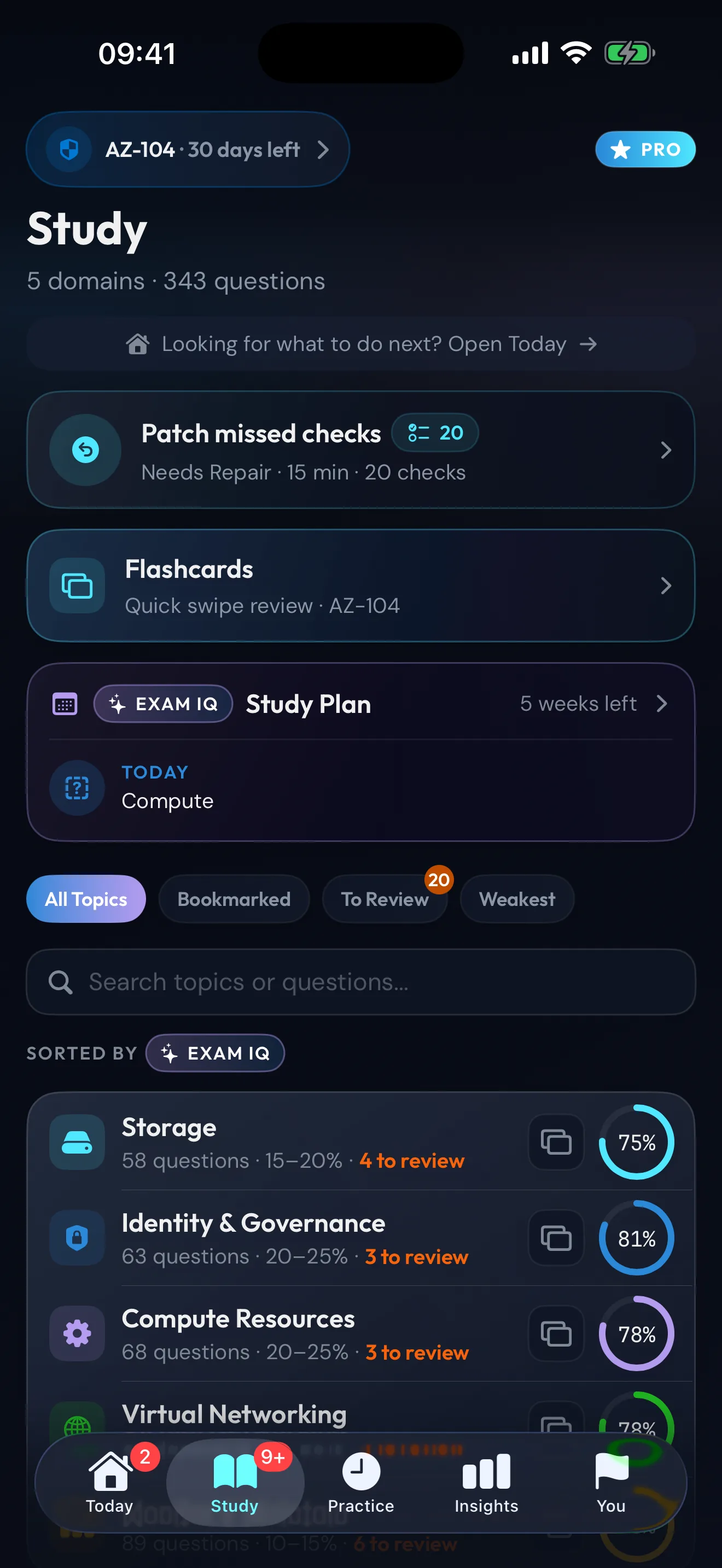
Azure Mastery writes a rationale for every option on every DP-900 question, so a wrong guess between Azure SQL Database and Managed Instance teaches you the distinction. Exam IQ predicts your score on-device, the study plan re-targets your weak domain, and the simulator runs at the real 45-minute length. Free to start, works offline.
Download Azure Mastery — freeAfter DP-900
What's next after DP-900
DP-900 does not expire and is not a formal prerequisite for anything — treat it as the on-ramp that confirms data is the right direction before two or three months on a role-based exam.
- To run and secure Azure SQL workloads in production — high availability, disaster recovery, performance, security — the next stop is DP-300 (Azure Database Administrator Associate), which builds on the relational-data domain here but expects hands-on T-SQL and configuration.
- To build the pipelines that load and shape data, pick a platform: DP-700 (Fabric Data Engineer Associate) goes deep on Microsoft Fabric — Dataflows Gen2, notebooks and PySpark, Eventstream, Lakehouse and Warehouse optimisation.
- DP-750 (Azure Databricks Data Engineer Associate) covers the same ground on Databricks instead — Lakeflow Connect, Unity Catalog governance, Spark job tuning. Most engineers pick one platform to match their employer's stack; some eventually sit both.
- Not sure administration or engineering fits, or whether Azure's general infrastructure track suits you better first? The Which Microsoft certification first? guide compares the Azure, security, and data tracks.
Frequently asked
DP-900 FAQs
How hard is the DP-900 exam?
One of the more approachable Fundamentals exams, since it stays conceptual: recognise scenarios like OLTP versus OLAP or which Azure SQL service fits a migration, rather than write SQL or configure a resource. Some IT background: one to two weeks. Data concepts genuinely new: three to four weeks.
How long should I study for DP-900?
One to two weeks if you already work in IT or software; three to four if data and cloud concepts are new. The exam rewards recognising the right service for a scenario over memorising definitions, so spend time on comparisons — SQL Database versus Managed Instance, Fabric versus Synapse — rather than flashcards.
Do I need DP-900 before DP-300, DP-700, or DP-750?
What is the passing score for DP-900?
700 out of 1000. The score is scaled, not a raw percentage, so it doesn't map to a fixed number of correct answers out of the roughly 40 to 60 questions. Treat 700 as a comfortable target — a handful of unfamiliar questions won't sink an otherwise solid attempt.
Does the DP-900 certification expire?
How much does DP-900 cost and can I retake it if I fail?
Pricing varies by country — check Microsoft's exam page for your local fee. If it doesn't go your way:
- You can sit your first retake after 24 hours.
- The second and third retakes each carry a 14-day wait.
- Maximum five sittings per rolling 12 months, booked and paid separately.
Ready to start on DP-900?
Confused between two DP-900 services? Every option gets its own rationale, and the study plan adapts around whichever one you keep missing. Free to start, works offline.
Download Azure Mastery — free iPhone & iPad · Free to start · No account required