Guide
How to pass AI-200: Azure AI Cloud Developer
A practical six-week route through containerised hosting, vector-capable data services, messaging, and observability for back-end Azure AI development — plus the data-service trade-offs that catch experienced developers off guard.
The exam
What is AI-200, and is it for you?
AI-200 earns the Microsoft Certified: AI Cloud Developer Associate credential, with the emphasis squarely on back-end services and components rather than the model or agent layer itself.
- Targets developers who contribute to every phase of building AI solutions on Azure — requirements, design, development, deployment, security, monitoring, and troubleshooting.
- You should already be comfortable with Python and Azure SDKs, Azure data management services, messaging and eventing, containerised applications, and vector databases before you sit it.
- It's the back-end development counterpart to AI-103: where AI-103 tests building the AI application itself — models, agents, retrieval — AI-200 tests the platform underneath, from container hosting to Request Unit tuning to distributed tracing.
- Became generally available on 1 July 2026, so it's still a young credential.
- Its May 2026 objective update consolidated a split app, security, and monitoring outline into four cleaner domains, and added pgvector on Azure Database for PostgreSQL and vector indexing on Azure Managed Redis as explicit objectives.
- Skills measured were last confirmed on 5 May 2026, so anchor your study to that live outline.
Format & domains
Exam format and skills domains
AI-200 mixes question styles: single-answer and multi-select items, ordering tasks around a deployment or troubleshooting workflow, and case studies that group several questions around one back-end architecture scenario.
- QuestionsRoughly 40–60
- Duration100 minutes (120-minute seat)
- Pass score700 / 1000 (scaled)
- DeliveryOnline or a test centre
- ValidityRenew free every year
- FeeVaries by country
The fee changes by country, so check Microsoft's certification page for the price where you live. The four skills domains and their weights, from the official May 2026 outline, are below.
| Domain | Weight |
|---|---|
| Develop containerized solutions on Azure | 20–25% |
| Develop AI solutions by using Azure data management services | 25–30% |
| Connect to and consume Azure services | 20–25% |
| Secure, monitor, and troubleshoot Azure solutions | 20–25% |
- Data management is the largest domain and the one with the newest content: Cosmos DB for NoSQL, Azure Database for PostgreSQL with pgvector, and Azure Managed Redis vector indexing together make up the exam's vector-search backbone.
- Azure OpenAI, Microsoft Foundry, and Azure AI Search can still appear as supporting context, but they're no longer top-level objective headings in their own right.
Six-week study plan
A realistic six-week study plan
Use the six-week plan below as a starting point if you already build backend Azure services against SDKs professionally; extend it when Cosmos DB, pgvector, or containerised AKS deployment are new to you. It gives the largest domain — data management services — two full weeks, with the remaining three domains taking one week each.
-
Develop containerized solutions on Azure
Hosting first, then orchestration.
- Build, store, version, and manage images with Azure Container Registry and ACR Tasks; deploy to App Service.
- Azure Container Apps: environment and revision management, event-driven scaling with KEDA.
- Deploy to AKS by manifest; monitor and troubleshoot logs, events, and connectivity on both platforms.
-
AI data solutions with Azure Cosmos DB for NoSQL
The largest domain starts here.
- Connect with the SDK and run queries; optimise Request Unit consumption via indexing policies and consistency levels.
- Store and retrieve embeddings for vector similarity search.
- Implement a change feed processor to react to new or updated items.
-
AI data solutions with PostgreSQL and Azure Managed Redis
Two more vector-capable stores to tell apart from Cosmos DB.
- Connect and query PostgreSQL by SDK; model schemas and indexing strategies; tune pgvector overhead.
- Configure resources for vector workloads; implement RAG patterns with metadata filters.
- Azure Managed Redis: caching, expiration, invalidation, vector indexing for similarity search.
-
Connect to and consume Azure services
Messaging first, then serverless compute.
- Azure Service Bus: dead-letter queue handling, topics, subscriptions.
- Azure Event Grid: filters, custom events, retries.
- Azure Functions: serverless APIs with triggers and bindings; configuring and deploying function apps.
-
Secure, monitor, and troubleshoot Azure solutions
Secrets and config, then the observability layer on top.
- Azure Key Vault: rotation and retrieval; Azure App Configuration for app settings.
- Tracing distributed systems with OpenTelemetry SDKs.
- Writing KQL queries to analyse logs and metrics.
-
Review and exam simulation
Revisit the data-service decision the exam leans on hardest, then prove you're ready.
- Which vector store fits which consistency, latency, and cost profile.
- Practise your weakest domain daily, then run two full-length timed simulations before you book.
Focus areas
The hardest AI-200 topics
AI-200 rewards specific configuration knowledge over general familiarity, so give these five areas focused practice.
Choosing the right vector store for the workload
- Cosmos DB, PostgreSQL with pgvector, and Azure Managed Redis all support vector similarity search.
- Match consistency requirements, latency budget, and relational needs to the right service, not whichever you know best.
Tuning performance under load
- "Scale up the tier" is rarely the answer the exam is looking for.
- Cosmos DB expects indexing-policy and consistency-level choices for Request Unit cost; PostgreSQL expects connection-optimisation and compute-sizing for latency and pgvector overhead.
Container hosting vs container orchestration
- App Service, Container Apps with KEDA, and full AKS solve overlapping problems at different levels of control and complexity.
- Match the requirement's scaling and orchestration needs to the lightest option that satisfies them.
Service Bus vs Event Grid for a given integration
- The exam names a specific integration requirement and expects the messaging pattern that fits it, not just "a queue".
- Service Bus suits ordered, transactional, dead-letter-aware messaging; Event Grid suits fan-out, filtered, retryable delivery to many subscribers.
Observability with real instrumentation detail
- AI-200 tests actual OpenTelemetry instrumentation and KQL query-writing, not "turn on Application Insights".
- Expect a scenario describing a tracing gap or log query requirement and asking you to write or fix the instrumentation.
How to practise
Practise the way the exam works
AI-200 rewards configuration judgement built through practice, not just documentation reading.
- Practise making a configuration choice before you read the explanation: given a scenario, choose an indexing policy, connection setting, or messaging pattern and explain how it meets the constraint.
- Check your reasoning against the answer, then revisit the service documentation for any detail you missed.
- Pair that with hands-on repetition: stand up a small Cosmos DB container with a vector index, connect Azure Database for PostgreSQL with pgvector, and wire a Container App to a Service Bus queue.
- A configuration option is far faster to recognise once you've set a similar one up yourself.
- Sit at least two full-length, mixed-domain simulator runs before you book, and go back over every wrong answer instead of just checking the score.
Configuration detail, not just definitions
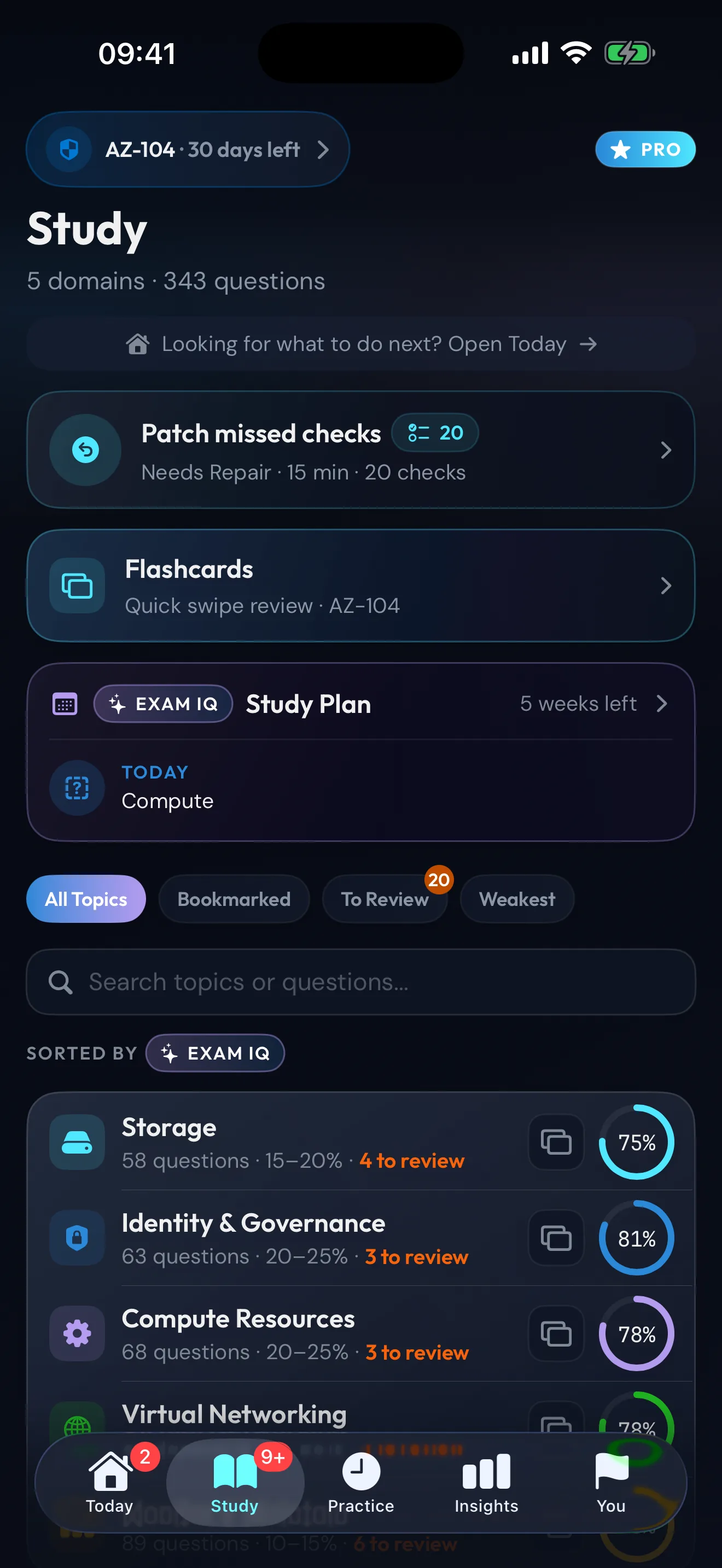
Azure Mastery writes a rationale for every option on every AI-200 question, so a wrong call on indexing policy or vector store teaches you the configuration detail, not just the score. Exam IQ gives you an on-device readiness score with a confidence range, and the study plan keeps circling back to your weak domain. Free to start, works offline.
Download Azure Mastery — freeExam day
Tactics for exam day
A few habits protect the marks you've already earned.
- Run the system check ahead of time if sitting online, and clear your workspace — the proctor scans the room first.
- Arrive early either way; a rushed start eats into your focus during the configuration-heavy scenarios.
- Budget ninety seconds to two minutes for each question, flagging anything uncertain with mark-for-review rather than dwelling.
- Read every data-service or messaging question twice — the trap is usually one consistency level, indexing choice, or delivery guarantee.
- Work through every question in a case study before advancing — most don't let you return once you've moved on.
- 700 out of 1000 is the scaled pass mark, so one unfamiliar configuration won't cost you the exam: decide and move forward.
Frequently asked
AI-200 FAQs
How hard is the AI-200 exam?
A back-end engineering exam more than an AI-concepts one: it assumes working Python or SDK experience and asks specific questions about indexing policies, connection pooling, and messaging patterns rather than definitions. New to Cosmos DB, pgvector, or Azure Managed Redis? Budget extra hands-on time for the vector-workload tuning detail.
How long should I study for AI-200?
The six-week plan above is a practical start if you already write backend Azure services against SDKs professionally. Extend it when Cosmos DB, pgvector, or containerised AKS or Container Apps deployment are new territory — the exam rewards specific configuration knowledge over general familiarity.
Do I need AI-901 before AI-200?
Not a formal prerequisite, but Microsoft's own path lists it as the current fundamentals route in. New to AI concepts and vector search at a conceptual level? Sit AI-901 first. Already building backend Azure services with vector data? Go straight to AI-200.
Is AI-200 the same as AI-103?
No. AI-200 validates back-end engineering for AI solutions — containers, vector-capable data services, messaging, observability. AI-103 validates the application layer itself: deploying models, building agents, RAG against Foundry. Many engineers eventually need both.
What is the passing score for AI-200, and does it expire?
700 out of 1000, scaled rather than a raw percentage, so it doesn't map to a fixed number of correct answers. Like other Associate certifications, AI-200 expires annually, with a free renewal assessment on Microsoft Learn inside the six-month window before expiry.
How much does AI-200 cost and can I retake it if I fail?
The fee varies by country, so check Microsoft's certification page for what it costs locally. If you don't pass:
- First retake: a 24-hour wait.
- Second and third retakes: 14 days between each.
- Five sittings maximum in any rolling 12-month window, each a separate booking.
Ready to start on AI-200?
No blind guessing on AI-200: every option carries a rationale, your study plan adapts to your weak domains, and Exam IQ predicts your score on-device. Free to start.
Download Azure Mastery — free iPhone & iPad · Free to start · No account required