AI-103: Predict your score.
Know what to study next.
See your predicted score, follow a study plan based on your answers, and revisit topics you're starting to forget. It all runs on your device.
557 practice questions
AI score prediction
100% offline
Download free
iPhone & iPad · Free to startOn your Mac? Scan to install
AI-103Azure AI Apps and Agents Developer
AI-103 · 30 days left ›
PREDICTED786 ±37✓ Exam Ready · 87% confidence
AI-103 Practice Questions & Exam Prep — Azure AI Apps and Agents Developer
Get exam-ready for AI-103 (Developing AI Apps and Agents on Azure) on iPhone or iPad. Azure Mastery uses on-device AI to predict your readiness across all five current AI-103 domains, build a personalised study plan from your weak spots, and surface topics you're forgetting. Core study stays on-device and works offline; optional sync uses your private iCloud account.
The exam
What is the AI-103 exam?
AI-103 is the exam for the Microsoft Certified: Azure AI Apps and Agents Developer Associate credential. It is aimed at Azure AI engineers who build, manage, and deploy agents and AI solutions with Microsoft Foundry. The exam expects practical Python experience and familiarity with general AI, generative AI, and Azure services.
AI-103 is hands-on and SDK-aware. It validates that you can plan and manage Azure AI solutions; implement generative AI and agentic solutions; build computer vision solutions; implement text analysis and speech workflows; and create information-extraction and retrieval pipelines. Expect scenarios involving Python, Foundry projects, models, agents, Azure AI Search, Content Understanding, security, evaluation, and observability.
The current AI-103 skills are measured as of 16 April 2026. Every question in Azure Mastery's AI-103 bank is mapped to that outline. Read the official Microsoft study guide.
Questions40–60 questions, mixed formats
Duration100 minutes (120 min seat)
Pass score700 / 1000
CostUSD $165 (≈ £128 UK)
ValidityRenew annually (Associate)
FormatOnline or test centre
Skills measured · 16 April 2026
AI-103 exam objectives
Five domains from Microsoft's current outline. Every domain below lists Microsoft's own skill groups verbatim from the official study guide, so you always know which domain you're being tested on and where your weak spots cluster.
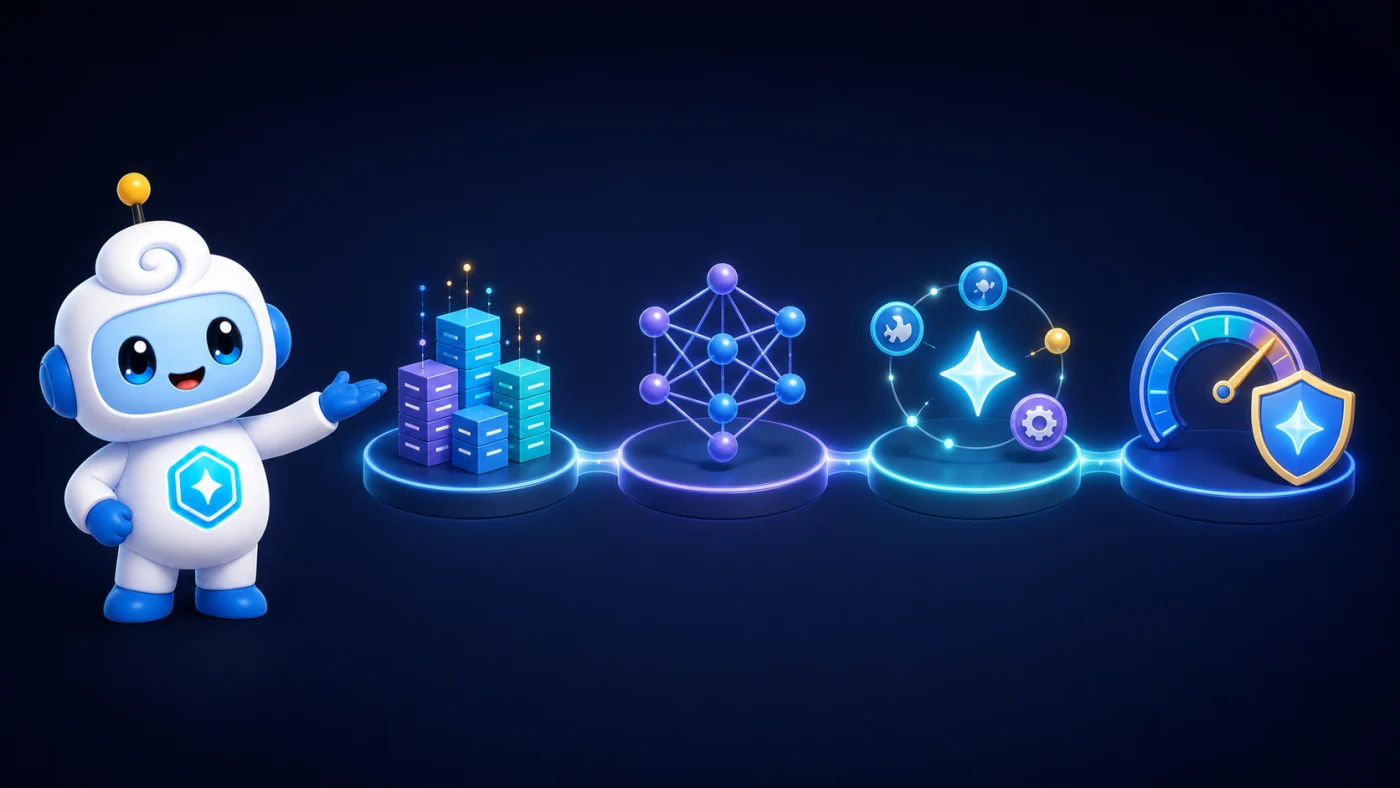
AI & agent skill mapDataModelsAgentsResponsible AI
Plan and manage an Azure AI solutionPublished weight 25–30%
150 exam-scoped practice questions in the app
Explore Plan topics
Choose the appropriate Foundry services for generative AI and agents
Set up AI solutions in Foundry
Manage, monitor, and secure AI systems
Implement responsible AI across generative AI and agentic systems
Tests architecture decisions made before any agent code: model-class choice, Foundry CI/CD, and keeping a live system observable and secure.
Governance basics — managed identity, private networking, responsible-AI guardrails — get skipped in favour of jumping straight to model choice.
Match a workload's stated latency, cost, and accuracy needs to a specific Foundry service before picking a model.
Implement generative AI and agentic solutionsPublished weight 30–35%
189 exam-scoped practice questions in the app
Explore Gen & Agents topics
Build generative applications by using Foundry
Build agents by using Foundry
Optimize and operationalize generative AI systems
The heaviest domain: covers RAG, multistep reasoning, and agents that call tools, hold memory, and hand off work to an orchestrator.
Evaluation gets treated as an afterthought, but the exam tests detecting fabrications and scoring relevance and safety directly.
Practise reading a production agent's tracing, token, and latency data as closely as you practise building the agent.
Design and implement image- and video-generation solutions
Design and implement multimodal understanding workflows
Implement responsible AI for multimodal content
Splits between generation — producing or editing images and video from prompts — and understanding: captions, visual Q&A, and classification.
Candidates apply text-based safety rules here, but visual responsible AI covers image-hidden prompt injection and brand-watermark policy too.
Decide generation or understanding first from the scenario's verb, then pick the matching Content Understanding feature.
Implement text analysis solutionsPublished weight 10–15%
74 exam-scoped practice questions in the app
Explore Text topics
Apply language model text analysis
Implement speech solutions
Covers two separate skill sets, language-model text analysis and speech, that candidates lump together as one "language services" bucket.
Struggling to name the exact Foundry tool or SDK call a stated text or audio requirement needs is the common miss.
Match the scenario's exact requirement — structured JSON, sentiment, or a custom speech model — to its specific Foundry call.
Implement information extraction solutionsPublished weight 10–15%
64 exam-scoped practice questions in the app
Explore Extraction topics
Build retrieval and grounding pipelines
Extract content from documents
Where retrieval and document intelligence meet: choosing semantic, hybrid, or vector search for a described grounding scenario.
Candidates treat OCR as the deliverable, but it's only a step toward structured or Markdown output for a RAG pipeline.
Practise configuring enrichment skills for text, image, and layout before assuming Content Understanding needs no setup.
Common traps
Where AI-103 candidates slip
Five recurring misconceptions that trip up otherwise well-prepared AI-103 candidates, grounded in the current skills outline.
Right-sizing the model, not maximising it
Candidates default to the largest multimodal model offered, when the scenario's latency, cost, and context needs point to a smaller one.
Latency, cost, and context length are the three levers Microsoft actually tests — raw capability rarely decides the answer.
Treat every "which model" question as a sizing problem first: check latency, cost, and context before capability.
RAG is not fine-tuning
Candidates reach for RAG when a scenario actually needs model customisation through fine-tuning, or the reverse.
RAG grounds answers in your own content at query time; fine-tuning changes the model's weights permanently instead.
Read for "answer from our current documents" — that phrase means retrieval, never fine-tuning.
One agent with tools vs. orchestrated agents
A single agent calling several tools and an orchestrator delegating to separate agents solve different shapes of problem entirely.
Scope is the tell: one agent's tools share its memory, while an orchestrator hands each specialised agent its own context.
Check whether the scenario needs one agent's shared memory and scope, or separate agents each with their own.
Filters, evaluators, and governance aren't the same control
Content filters, evaluators, and governance controls all sound like "safety", but each operates at a different point in the pipeline.
Runtime filtering blocks content as it flows, evaluation scores it afterwards, and governance sets the rules before either runs.
Ask when the control acts — before, during, or after the agent runs — to sort it into the right category.
Content Understanding is a full extraction pipeline
Candidates treat Content Understanding as simple OCR, missing the structured output and multimodal analysis the exam actually tests.
Structured JSON or Markdown output, multimodal analysis, and a direct connection into a RAG pipeline all sit inside Content Understanding.
Look for what happens after extraction: structured JSON, Markdown, or a handoff into the next pipeline stage.
Designed for AI-103
How Azure Mastery helps you pass AI-103
Exam-specific practice
557 AI-103 practice questions aligned to the published skills outline.
Coverage leans hardest on planning and agentic implementation, the two domains Microsoft weights up to 35% each.
Practise right-sizing a model to a stated latency, cost, and context budget — the exam's recurring scenario shape.
Predicted score
Exam IQ forecasts your AI-103 score on-device after roughly 30 questions, confidence range attached.
It names whether generative-agent building or governance and evaluation is dragging that number down.
Compare all five domains to see which one is holding your predicted score back before you book.
Adaptive study plan
Your plan leans hardest on implementing generative AI and agents, the domain Microsoft weights up to 35%.
Miss a RAG, orchestration, or Content Understanding question and the next session surfaces that domain first.
Once a topic sticks across three sessions running, the plan shifts focus to whatever's next weakest.
Knowledge decay
Forget the RAG-vs-fine-tuning distinction early on and later evaluation and governance questions get harder too.
Watch the Today screen for a decay flag and revisit that topic before it slips for good.
Run a Focus Weak Spots session and fading topics come back into rotation without you hunting for them.
Exam rehearsal
Practise holding focus through a full 100-minute session, matching AI-103's real length.
Every question is original, and each session's domain mix tracks the published weighting.
The live exam's exact interface and question order are Microsoft's call, not Azure Mastery's.
Answer Coach
Untangles AI-103's near-identical pairs: RAG vs fine-tuning, and one agent with tools vs an orchestrated multi-agent solution.
Miss a question and Answer Coach points to the exact scenario detail that should have changed your answer.
Supported devices can offer an on-device rewrite, but it's always checked against the written explanation first.
Aura guidance
Aura changes its suggestions as your first week of AI-103 practice unfolds.
Every session closes with a quick recap covering what improved, what needs another look, and where to go next.
Private by design
Your AI-103 answer history, readiness gauge, and Answer Coach notes never leave your device by default.
There's no Azure Mastery account or server that ever sees your AI-103 study data.
Turn on sync and it stays inside your own private iCloud account — nothing else.
6-week study plan
Suggested AI-103 study plan
Build from Foundry foundations to agents, multimodal apps and information extraction. Follow this six-week route, with focused review and timed practice at the end.
Plan and manage AI
Review Foundry services, models and deployment choices.
Plan CI/CD, monitoring and cost management.
Apply security and responsible AI considerations.
Generative AI and agents
Build RAG solutions with Foundry SDKs.
Explore tools, memory and multi-agent orchestration.
Review safeguards, evaluation and tracing.
Computer vision
Explore image and video generation and editing.
Review multimodal understanding and Content Understanding.
Consider accessibility outputs and visual safety.
Text and speech
Practise extraction, summarisation and sentiment analysis.
Explore translation, speech-to-text and text-to-speech.
Review audio-reasoning scenarios.
Information extraction
Combine multimodal ingestion and OCR.
Compare semantic, hybrid and vector search for RAG.
Produce structured outputs with Content Understanding.
Review and rehearse
Use Focus Weak Spots to revisit weaker topics.
Complete two timed, 100-minute Exam Simulator sessions.
Review mistakes and plan further practice.
Inside the app
Nine interactive practice formats, on iPhone
Azure Mastery has nine interactive formats for exam practice. The examples below show original AI-103 practice questions in Azure Mastery on iPhone and iPad. The exam simulator uses timed sessions with the published domain weights. Microsoft's live interface and question mix may differ.
How many dimensions does the text-embedding-3-large model produce by default?
8,191
3,072
256
1,536
Multiple choice
An original AI-103 practice question with one correct answer. The app explains every option after you answer.
Exam-specific sample
Which TWO of the following are valid status values for a background response in the current Foundry runtime? (Select TWO)
Paused
Queued
Restarting
Completed
Multi-select
An original AI-103 multi-select question. Select all the correct options to earn the mark.
All-or-nothing
Arrange the steps in the correct order to establish a governed Microsoft Foundry environment for a development team.
⋮⋮1Create a Microsoft Foundry resource in the selected subscription and…
⋮⋮2Configure shared security settings, model deployments, and reusable…
⋮⋮3Create a Foundry project for the development team under that resource
⋮⋮4Assign the team the least-privilege Foundry roles at the appropriate…
⋮⋮5Build agents and run evaluations within the project
Drag-and-drop
An original AI-103 ordering question you can answer by touch on iPhone and iPad.
Interactive item
In the Microsoft Foundry portal, select the TWO settings that configure content filtering for a deployed model.
Hotspot
An original AI-103 question with a visual prompt, designed for touch on iPhone and iPad.
Tap target
Contoso Insurance — Governing a multimodal claims agent Contoso Insurance is building a Foundry agent that receives claim forms, photographs, and voice notes. It extracts claim details, retrieves policy wording, and can…
1Which agent design best satisfies the payment-control requirement?
2How should the application handle instructions detected inside an uploaded claim…
3Which extraction design best meets the structured-field and source-evidence…
4Which telemetry design best supports investigation of an unsafe or poorly…
Case studies
An original AI-103 case study with several questions about the same requirements and environment.
Multi-question
✕Your answer: 8,191
✨ Answer Coach:8,191 is the maximum number of input tokens text-embedding-3-large can process in a single call — an input length limit, not the dimension count of the output vector.
— grounded in authored certification guidance
Answer Coach
Answer Coach explains why the answer is correct and, where available, why each option is right or wrong. It helps you understand a mistake and remember the distinction. Read explanations after each question or at the end of a practice test. On supported devices, optional AI can reword a note on your device after checking it against the written guidance.
App exclusive
Frequently asked
AI-103 FAQs
How much does the AI-103 exam cost?
The AI-103 voucher costs USD $165 in the United States (around £128 in the UK; regional pricing varies). Because AI-103 is a role-based Associate exam rather than a Fundamentals-tier one, Microsoft rarely bundles it into free promotional vouchers — watch for occasional offers around Microsoft Build or Microsoft Ignite instead. Renewal itself is free.
Does the AI-103 certification expire?
Yes — like every Microsoft Associate certification, AI-103 expires annually. Renewal is a free, short online assessment on Microsoft Learn, available in the six-month window before expiry and scoped to recent skills-outline updates. AI-901, the Fundamentals-tier exam, doesn't expire — only role-based certifications like AI-103 do.
What is the AI-103 retake policy if I fail?
How much time you need before retaking AI-103 depends on your attempt number; every attempt needs its own voucher.
First retake: after 24 hours.
Second and third retakes: a 14-day wait each.
Cap: five attempts per rolling 12 months.
What does the AI-103 exam format look like?
AI-103 runs as a 100-minute session (120 minutes with seat time) of 40–60 questions, taken online with a proctor or at a test centre, and scored out of 1000 with a 700 pass mark. Azure Mastery's bank practises the same formats: multiple choice, multi-select, ordering, matching, and case studies.
How long should I study for AI-103?
Plan for several weeks of focused study if you already write Python and know Azure AI services; extend that if Foundry, agents, or multimodal AI are new to you. The exam spans five distinct domains, so breadth matters as much as depth. Azure Mastery's readiness gauge shows when you've closed the gap.
AI-103 vs AI-102 — different roles?
AI-102 retired on 30 June 2026. AI-103 replaced it as the current Azure AI Apps and Agents Developer Associate exam, a genuinely new outline that reflects how far the underlying platform has shifted toward Microsoft Foundry, agentic patterns, and multimodal content since AI-102.
AI-103 vs AI-901 — which should I take first?
Take AI-901 first if generative AI and Microsoft Foundry are unfamiliar concepts — it's the Fundamentals exam and assumes no coding. AI-103 assumes you can already write Python and expects hands-on familiarity with Foundry projects, agent tools, retrieval, and evaluation. Candidates with existing development experience sometimes skip AI-901 and go straight to AI-103.
Do I need real Foundry or Python experience before I start?
Not to begin studying, but AI-103 is written for candidates who already develop with Python and have touched Azure services — it isn't an intro-to-AI exam. If you're newer to development, working through Microsoft Foundry's own quickstarts alongside Azure Mastery's practice questions will close that gap faster than question practice alone.
Is Azure Mastery free for AI-103 prep?
The app is free to download, with a free allowance of AI-103 questions to try Answer Coach, the readiness gauge, and the adaptive plan before you commit. The full 557-question AI-103 bank unlocks with a one-time exam-pack purchase, or a subscription or lifetime upgrade unlocks every exam in the catalogue.
Does AI-103 practice work offline?
All of it — question practice, scoring, and the readiness prediction run on-device, so a flight or an offline commute doesn't interrupt your study streak. No account is required, and your data stays on your device unless you turn on optional private iCloud sync.
Free study guides
Free guides that pair with AI-103
Where AI-103 fits
Certification paths that include AI-103
AI-103 is the Azure AI Apps and Agents Developer Associate exam. It follows AI-901 as the current fundamentals route and replaces the retired AI-102 route. Tap any linked exam below to see its dedicated study app page.
AI-103 sits at the Azure AI apps and agents developer Associate tier. AI-901 is the current fundamentals foundation; AB-620 is the complementary Copilot Studio route for low-code agent builders.
Ready to pass AI-103?
Download Azure Mastery free. 557 AI-103 practice questions across all five domains, AI score prediction, full-length exam simulator, adaptive study plan. iPhone & iPad.