Guide
AI-103 vs AI-200: AI apps and agents, or AI cloud developer?
Two 2026 Azure AI Associate exams that sit side by side rather than in sequence. See which layer of the AI stack each one certifies.
Quick answer
AI-103 or AI-200: the short version
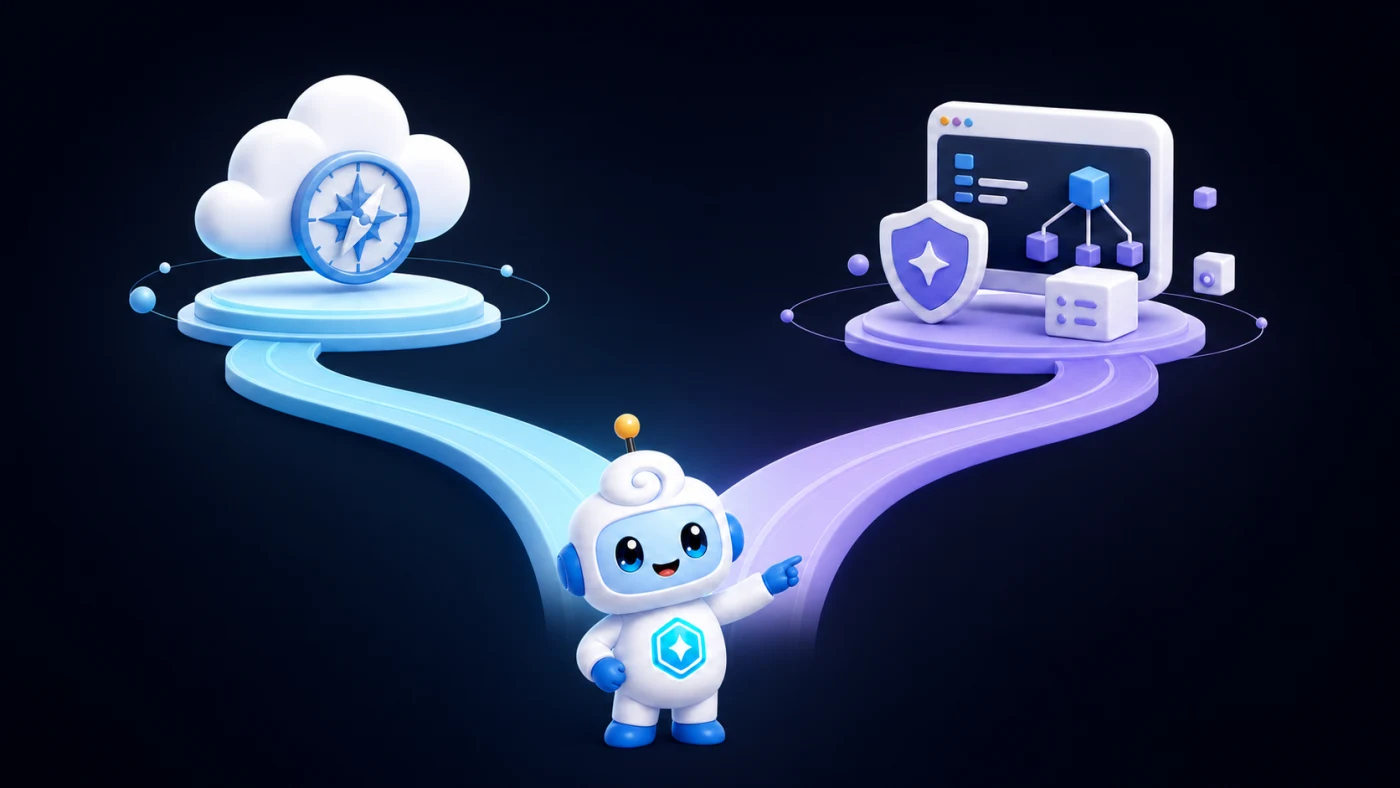
AI-103 and AI-200 are parallel Associate specialisations. Choose the one that matches your work: AI applications and agents, or the cloud infrastructure that supports them.
Choose AI-103 if you build the AI itself
- Right if your job is choosing and deploying models in Microsoft Foundry, building generative and agentic applications, implementing RAG, and shipping vision, text, or extraction solutions.
- Expects working Python and hands-on familiarity with Foundry SDKs.
Choose AI-200 if you build the cloud back end underneath it
- Right if your job is containerised hosting, wiring vector-capable data services like Cosmos DB and PostgreSQL, connecting services through Service Bus and Functions, and securing the result.
- Expects Azure SDK fluency and infrastructure judgement more than model-behaviour judgement.
Neither is a prerequisite for the other. See "Is one a prerequisite for the other?" below for how the two fit together on a full-stack AI team.
Side by side
AI-103 vs AI-200 at a glance
Every figure below is pulled from the current Microsoft skills outline for each exam, not a guess.
| Category | AI-103 | AI-200 |
|---|---|---|
| Credential | Microsoft Certified: Azure AI Apps and Agents Developer Associate | Microsoft Certified: AI Cloud Developer Associate |
| Best for | AI engineers who build, evaluate, and ship generative and agentic solutions with Microsoft Foundry | Backend developers who build the compute, data, and integration layer an AI solution runs on |
| Domains | 5: plan & manage; generative AI & agentic solutions; computer vision; text analysis; information extraction | 4: containerised solutions; AI data services; connect & consume services; secure, monitor & troubleshoot |
| Format | 40–60 questions, 100 minutes (120-minute seat) | 40–60 questions, 100 minutes (120-minute seat) |
| Question style | Multiple choice and multi-select, mostly Foundry project, model, and agent-configuration scenarios | Multiple choice and multi-select, mostly deployment, data-service, and connectivity scenarios |
| Pass score | 700 / 1000 | 700 / 1000 |
| Typical prep time | Five to eight weeks; longer if generative AI development or Python is new to you | Four to seven weeks with backend Azure experience; longer if containers or vector databases are new to you |
| Renewal | Renew annually, free online assessment | Renew annually, free online assessment |
| Skills outline | Updated 16 April 2026 | Updated 5 May 2026 |
Exam fees vary by country for both, so check Microsoft's own pages for the price where you live: the AI-103 study guide and the AI-200 study guide both link through to registration and current pricing.
What AI-103 actually tests
What AI-103 actually tests
AI-103 has five domains, with the most weight on generative AI and agentic solutions. You'll need to explain model and agent behaviour and choose the right Foundry capability for a task.
| Domain | Weight |
|---|---|
| Plan & manage an Azure AI solution | 25–30% |
| Implement generative AI & agentic solutions | 30–35% |
| Implement computer vision solutions | 10–15% |
| Implement text analysis solutions | 10–15% |
| Implement information extraction solutions | 10–15% |
- Planning covers choosing the right Foundry service and model family for a task, designing infrastructure and deployment options, monitoring quotas and drift, and applying responsible AI guardrails and audit trails.
- The generative and agentic domain covers building applications with LLMs and multimodal models, implementing retrieval-augmented generation, and building agents with tool integration, orchestrated multi-agent workflows, and observability through tracing and token analytics.
- The three smaller domains round out the practical surface: image and video generation with responsible-AI content filters, language-model text analysis and speech workflows, and retrieval pipelines combining semantic, hybrid, and vector search with document extraction through Content Understanding.
What AI-200 actually tests
What AI-200 actually tests
AI-200 focuses on the Azure back end for AI workloads: containers, vector-capable data stores, and event-driven integration. Models, prompts, and agent design are outside its domains.
| Domain | Weight |
|---|---|
| Develop containerised solutions on Azure | 20–25% |
| Develop AI solutions using Azure data services | 25–30% |
| Connect to & consume Azure services | 20–25% |
| Secure, monitor & troubleshoot Azure solutions | 20–25% |
- Containerised solutions covers building and versioning images with Azure Container Registry, deploying to Azure Container Apps with event-driven scaling through KEDA, and running manifests on Azure Kubernetes Service.
- AI data services, the largest domain, is where AI-200 earns its name: Azure Cosmos DB for NoSQL with vector similarity search, pgvector workloads in Azure Database for PostgreSQL, and caching and vector indexing in Azure Managed Redis.
- Connect and consume covers Service Bus, Event Grid, and Azure Functions; the final domain covers Key Vault, App Configuration, OpenTelemetry tracing, and writing KQL queries to diagnose a solution once it's live.
Prerequisite question
Is one a prerequisite for the other?
No. AI-103 and AI-200 are both standalone Associate exams, and Microsoft does not require either as a prerequisite for the other.
- Each optionally follows AI-901 (Azure AI Fundamentals) as a conceptual lead-in, but the two don't lead into each other — they run in parallel as different specialisations in the same broad Azure AI field.
- That's deliberate: AI-103 assumes the Foundry project, the deployed model, and the underlying data store already exist and tests what you build with them; AI-200 tests whether you can stand the infrastructure up, connect it, secure it, and keep it running.
- A team building a production AI product typically needs both skill sets, but rarely from the same person on day one.
- No strong pull either way? Pick the one whose domain list reads as more familiar right now — AI-103 if Foundry SDKs, prompts, and RAG pipelines feel comfortable; AI-200 if Cosmos DB, Container Apps, and Service Bus do.
- There's no efficiency gained from sitting one before the other, since the domain content barely overlaps.
Career value
How each certification helps your career
Each certification signals a different layer of the AI product to a hiring manager.
- AI-103 is the credential for "AI engineer", "AI application developer", or "AI agent developer" roles — anywhere the job is choosing models, designing agent behaviour, and shipping generative features.
- It demonstrates you can evaluate a model or agent for fabrication, relevance, and safety, not just wire an API call.
- AI-200 is the credential for "AI cloud developer" or "backend engineer for AI systems" roles, where the job is making sure the vector database, containerised inference service, and message queue behind an AI product hold up under load.
- It's also this site's suggested next step for anyone whose AZ-204 (Azure Developer Associate) is ageing out, since AZ-204 retired on 31 July 2026 and AI-200's compute, data, and integration domains are the closest current match to that skill set.
- Neither guarantees a job or pay rise; both give you a Microsoft credential you can cite in a job application or promotion discussion.
Take both?
Should you take both AI-103 and AI-200?
For engineers on a full-stack AI platform team, both certifications map cleanly onto real, distinct parts of the job.
- Responsible for a product end to end, from the agent's behaviour down to the database it queries? Together they cover the AI application layer and the cloud infrastructure layer with almost no gap between them.
- Only work one side of that line? Taking both offers limited extra signal — a model- and agent-focused engineer gets little from AI-200's container and messaging domains, and a backend-infrastructure engineer gets little from AI-103's prompt-engineering and vision domains.
- Sit the one that matches your role and revisit the other only if your responsibilities expand.
- Plan to sit both? There's no real efficiency in sequencing them tightly together, since the domain overlap is minimal — treat them as two separate study projects. The AI-103 study guide and the AI-200 study guide each lay out their own six-week plan.
One download, two independent banks
Azure Mastery carries both the AI-103 and AI-200 question banks, each with a rationale for every option, so moving between the application layer and the infrastructure layer doesn't mean switching apps. Every bank gets its own on-device Exam IQ score with a confidence range and its own adaptive plan. Free to start, works offline.
Download Azure Mastery — freeFrequently asked
AI-103 vs AI-200 FAQs
Is AI-200 a prerequisite for AI-103, or the other way round?
No. Neither requires the other; Microsoft's certification paths list them as parallel Associate specialisations, not a sequence. AI-901 is an optional conceptual lead-in for both, but AI-103 and AI-200 sit side by side.
What's the real difference between AI-103 and AI-200?
AI-103 certifies the AI application and agent layer: models in Foundry, RAG and agentic workflows, vision and extraction pipelines. AI-200 certifies the infrastructure those solutions run on: containers, vector-capable data services, event-driven messaging, security and monitoring. One is model-facing, the other is back-end-facing.
Which one should I take if I'm building a chatbot or an AI agent?
AI-103. Its Implement Generative AI and Agentic Solutions domain (30-35%) covers exactly this: building agents with Foundry, tool schemas, conversation memory, multi-agent orchestration. AI-200 doesn't test conversational or agentic design at all.
Which one should I take if I own the data and messaging layer underneath an AI solution?
AI-200. Its two largest domains cover exactly that: Cosmos DB, PostgreSQL, and Managed Redis for vector storage, plus Service Bus, Event Grid, and Functions for connecting services. AI-103 assumes those services exist and focuses on what the application does with them.
Do AI-103 and AI-200 expire the same way?
Yes. Both are Associate certifications, renewed annually and free, through a short assessment on Microsoft Learn during the six-month window before expiry. Passing one doesn't affect the other's renewal clock.
Can I take both, and does one make the other easier?
Yes, and it's a common pairing on a full-stack AI platform team. The two domain lists barely overlap, so passing one doesn't meaningfully shorten study time for the other, but both assume comparable Python fluency and Azure identity familiarity, so that groundwork only needs building once.
Ready to start on AI-103 or AI-200?
Application layer or infrastructure layer, your bank adapts its plan around your weak domains and predicts your score on-device before you book. Free to start, no account required.
Download Azure Mastery — free iPhone & iPad · Free to start · No account required