Guide
How to pass AI-103: Developing AI Apps and Agents on Azure
A practical six-week route through Microsoft Foundry, agent development, and the vision, text, and retrieval domains — plus the topics that catch experienced Python developers off guard.
The exam
What is AI-103, and is it for you?
AI-103 earns the Microsoft Certified: Azure AI Apps and Agents Developer Associate credential, the exam most job adverts now mean by "Foundry experience" or "Azure AI application development".
- Targets Azure AI engineers who build, manage, and deploy agents and generative AI solutions with Microsoft Foundry, rather than a generic AI-adjacent skill set.
- Expects practical Python experience and familiarity with general AI, generative AI, and Azure services.
- Replaced the retired AI-102 (Azure AI Engineer Associate) route; the current fundamentals lead-in for candidates newer to the field is AI-901.
- Sits at the associate tier and is terminal there — no further exam is required to sit it or builds on it.
- Became generally available on 1 June 2026, so it's still a young credential and solid preparation material is hard to find.
- It's hands-on and SDK-aware: a Foundry project configuration, an agent workflow, or a retrieval pipeline, and a question on what it does or what to change, rather than a term to define.
- Skills measured were last confirmed on 16 April 2026 — anchor your study there, not to older AI-102 material, which covers a different, retired exam.
Format & domains
Exam format and skills domains
AI-103 mixes question styles rather than sticking to plain multiple choice. Expect single-answer and multi-select questions, ordering tasks around a pipeline or workflow, and short case studies that group several questions around one Foundry project scenario.
- QuestionsRoughly 40–60
- Duration100 minutes (120-minute seat)
- Pass score700 / 1000 (scaled)
- DeliveryOnline or a test centre
- ValidityRenew free every year
- FeeVaries by country
The exam fee changes from country to country, so check Microsoft's certification page for the price where you live. The five skills domains and their weights, from the official April 2026 outline, are below.
| Domain | Weight |
|---|---|
| Plan and manage an Azure AI solution | 25–30% |
| Implement generative AI and agentic solutions | 30–35% |
| Implement computer vision solutions | 10–15% |
| Implement text analysis solutions | 10–15% |
| Implement information extraction solutions | 10–15% |
Planning and generative-and-agentic work together make up roughly 60% of the exam, so they deserve the largest share of your revision. The three remaining domains — vision, text, and extraction — are lighter individually but easy to underrate as a group, since together they still outweigh either of the big two on their own.
Six-week study plan
A realistic six-week study plan
Use the six-week plan below as a starting point if you already build against Azure AI services or LLM APIs professionally; extend it when Foundry and agent orchestration are new to you. It maps the domains roughly in order of weight, with the largest domain split across two weeks.
-
Plan and manage an Azure AI solution
The foundation domain: choosing the right Foundry service for a task before you build anything.
- Model families, grounding, vector search, memory and tool integration.
- Infrastructure design, deployment options, CI/CD for Foundry projects; quotas, scaling, monitoring.
- Responsible AI: guardrails, evaluators, trace logging, oversight modes.
-
Build generative applications with Foundry
The largest domain, so give it real hands-on time, not just reading.
- Deploy and consume LLMs, small models, code models, multimodal models through Foundry.
- Implement RAG; design tool-augmented and multistep reasoning workflows.
- Evaluate models for fabrications, relevance, quality, safety; connect an app via the SDKs.
-
Build and optimise agents with Foundry
Define the agent, then tune it.
- Agent roles, goals, tool schemas; combine retrieval, function-calling, conversation memory.
- Orchestrated multi-agent solutions and autonomous workflows with approval safeguards.
- Prompt engineering, self-critique loops, tracing, token analytics, latency breakdowns.
-
Computer vision solutions
Split generation from understanding — the two get blurred constantly.
- Image and video generation from text and reference media; inpainting and mask-based editing.
- Multimodal understanding: captioning, visual question-answering, alt-text, Content Understanding pipelines.
- Responsible AI for visual content: unsafe-imagery filters, indirect prompt injection via embedded text.
-
Text analysis and information extraction
Two lighter domains that reward the same retrieval instinct.
- Entity, topic, structured JSON extraction; sentiment and safety detection; Azure Translator versus LLM-powered flows.
- Speech-to-text and text-to-speech for agentic interactions.
- Semantic, hybrid, and vector search; RAG ingestion with OCR; Content Understanding analysers.
-
Review and exam simulation
Responsible AI and Foundry deployment detail thread through every domain, so revisit both before you sit down.
- Re-walk responsible AI instrumentation and deployment detail across all five domains.
- Drill your weakest domain daily.
- Sit two full-length timed practice runs before you book.
Focus areas
The hardest AI-103 topics
Across all five AI-103 domains, practise choosing the Foundry capability that fits a task. These five areas deserve particular attention.
Choosing a retrieval and grounding method
- Semantic, hybrid, vector, and plain keyword search all show up as options, and defaulting to the newest-sounding one is the common mistake.
- Match the method to the data shape and accuracy requirement, and know which Foundry service hosts each one.
Multi-agent orchestration and safeguards
- Questions test the balance of autonomy and approval control: when a workflow runs unattended versus when it needs a human-in-the-loop checkpoint.
- Learn what each safeguard actually restricts, including how tool-access constraints limit an agent's reach.
Generation versus understanding in vision
- The vision domain splits into generating new images and video and understanding existing ones, and the two blur easily.
- Sort controls correctly: inpainting and mask-based edits are generation; captioning and visual question-answering are understanding.
Speech and translation service boundaries
- Text analysis blends dedicated services with LLM-powered flows, and defaulting to whichever you learned first costs marks.
- Weigh Azure Translator against prompt-based translation, and standard speech-to-text against custom speech models, by accuracy, latency, and customisation needs.
Responsible AI instrumentation, not just policy
- AI-103 tests the mechanics — evaluators, safety evaluations, trace-based auditing, provenance metadata — not the general principles.
- Expect a scenario naming a specific risk, such as an ungrounded response or indirect prompt injection through an image, and asking which instrumentation catches it.
How to practise
Practise the way the exam works
Reading Foundry documentation builds recognition, not recall, and AI-103 tests recall of specific SDK and service behaviour under time pressure.
- Retrieval practice: answer from memory before you check the explanation — the effort of pulling a fact out of your own head is what fixes it, especially for the "which Foundry service" decisions the exam is built on.
- Spaced repetition: come back to a domain a few days after first studying it rather than covering it once and moving on; the responsible-AI detail you nailed in week one is exactly what fades by week five if you never revisit it.
- Hands-on repetition with the SDK itself: deploy a small Foundry project, wire up a basic RAG flow, and build one simple agent with a single tool — reading a code snippet gets far faster once you've written a similar one yourself.
- Finish with at least two full-length, mixed-domain simulator runs before you book, and review every wrong answer rather than just the score.
A rationale for every Foundry decision
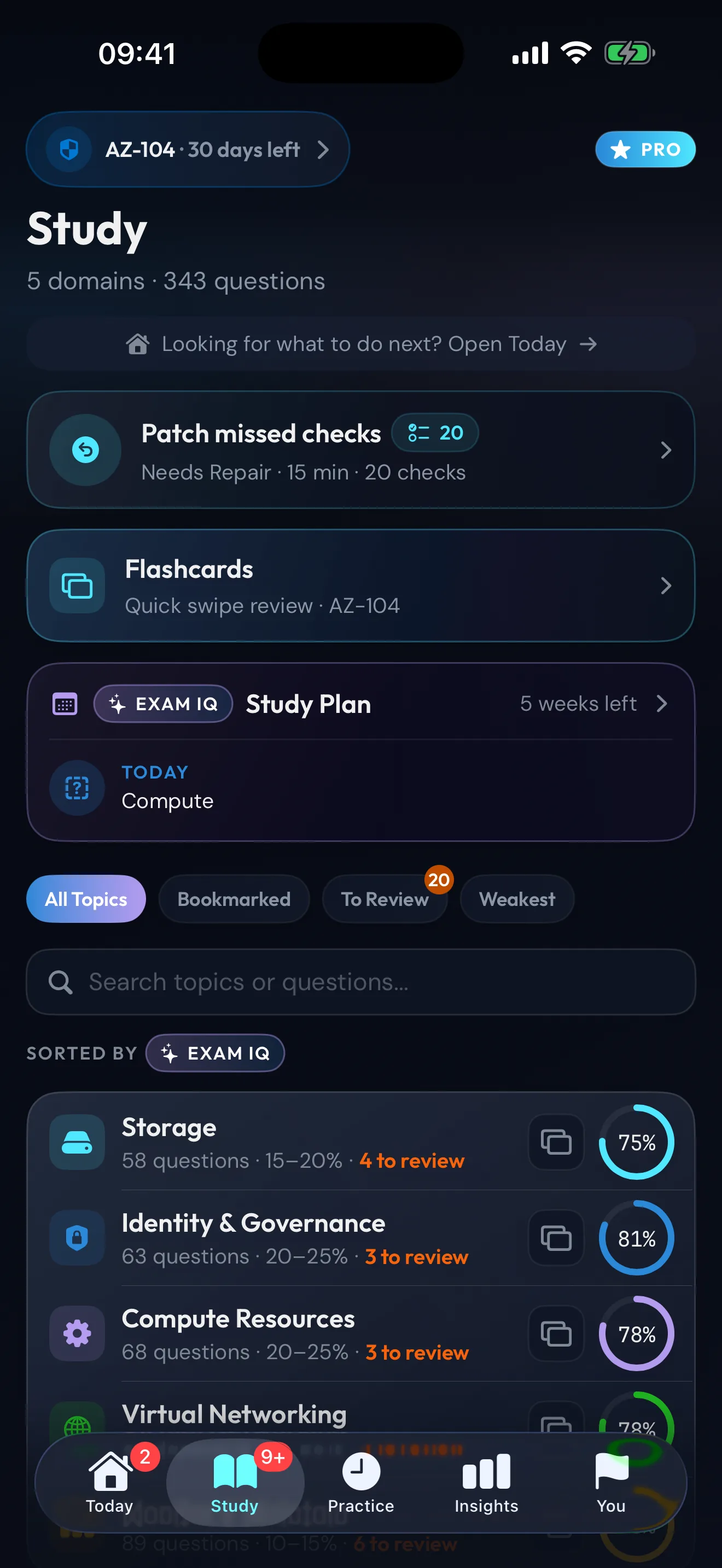
Azure Mastery writes a rationale for every option on every AI-103 question, so a wrong call on retrieval method or agent safeguard teaches you the reasoning, not just the score. Exam IQ predicts your readiness on-device with a confidence range, and the simulator runs at blueprint weight. Free to start, works offline.
Download Azure Mastery — freeExam day
Tactics for exam day
A few habits protect the marks you've already earned.
- Run the system check the evening before if you're sitting online, and clear the desk fully — proctors sweep the room on camera.
- Arrive early regardless of format — Foundry scenario questions punish a rushed, unsettled start.
- Plan on ninety seconds to two minutes per question and flag anything uncertain with mark-for-review instead of stalling.
- Read Foundry SDK and pipeline configuration questions twice — the trap is usually one parameter, service choice, or scope.
- Complete every question in a case study before moving on, since you typically can't return to one afterward.
- Remember the pass mark is 700 out of 1000, scaled. An unfamiliar question isn't a disaster: make your call and keep moving.
Frequently asked
AI-103 FAQs
How hard is the AI-103 exam?
Demanding, because it assumes working Python experience and asks you to reason about Foundry SDK behaviour, not just recall service names. Expect scenarios showing a model deployment, agent workflow, or retrieval pipeline that ask what to change or why it behaves a certain way. New to generative AI development? Budget extra hands-on time.
How long should I study for AI-103?
The six-week plan above is a practical start if you already write Python against AI or Azure services professionally. Extend it when Foundry, agent orchestration, and RAG are new territory — the exam rewards hands-on SDK time over reading alone. Use your domain-level results to decide when to add or repeat a week.
Do I need AI-901 before AI-103?
Not a formal prerequisite, but Microsoft's own path lists it as the current fundamentals route in. New to AI concepts, responsible AI, and Foundry at a conceptual level? Sit AI-901 first. Already working with Python and Azure AI services day to day? Go straight to AI-103.
What is the passing score for AI-103?
700 out of 1000. The score is scaled, not a raw percentage, so it doesn't map to a fixed number of correct answers. Multi-part items usually award one point for each correctly answered component unless the question states otherwise, so treat 700 as a comfortable target, not a line to scrape over.
Does the AI-103 certification expire?
Yes, annually, and renewal is free: a short assessment on Microsoft Learn inside the six-month window before expiry. It targets recent skills-outline updates, so staying current is manageable if you keep working with Foundry.
How much does AI-103 cost and can I retake it if I fail?
What you pay depends on your country — check Microsoft's certification page for the local fee. If you don't pass:
- First retake: wait 24 hours.
- Second and third retakes: each needs a 14-day wait.
- Five attempts is the cap in any rolling 12-month window, each its own booking.
Ready to start on AI-103?
AI-103 practice in Azure Mastery includes a rationale for every option, an on-device Exam IQ score with a confidence range, and a blueprint-weighted simulator — free to start, no account needed.
Download Azure Mastery — free iPhone & iPad · Free to start · No account required