Guide
How to pass AB-620: Copilot Studio AI Agent Builder
A practical six-week route through planning, building, and testing agents in Microsoft Copilot Studio — from topics and generative answers to multi-agent orchestration and lifecycle management.
The exam
What is AB-620, and is it for you?
AB-620 earns the Microsoft Certified: AI Agent Builder Associate credential, the exam behind what a job advert now calls "Copilot Studio developer" or "agent builder".
- Targets professional developers and advanced builders who design, build, extend, and integrate custom agents in Microsoft Copilot Studio for enterprise-grade scenarios, rather than a generic Power Platform generalist role.
- Typical candidates: IT application developers, consultants, or ISV partners building scalable agent solutions, comfortable with Copilot Studio topics and flows, Dataverse and Power Fx, Power Platform environments, generative AI concepts, and the Model Context Protocol and Agent2Agent protocol.
- Became generally available on 23 April 2026, so it's a young credential without much prep material in circulation yet.
- The current fundamentals lead-in for candidates newer to AI concepts is AI-901; AB-620 sits at the associate tier, terminal there — no further exam is required.
- It's scenario-driven: a Copilot Studio topic configuration or generative-answers setup and a question on what to change, or a business constraint that rules out an otherwise sensible option.
- Skills measured were last updated on 21 April 2026, so anchor your study to that live outline.
Format & domains
Exam format and skills domains
AB-620 mixes question styles: single-answer and multi-select items, ordering tasks around an agent flow or a lifecycle process, and short case studies that group several questions around one Copilot Studio scenario.
- QuestionsRoughly 40–60
- Duration100 minutes (120-minute seat)
- Pass score700 / 1000 (scaled)
- DeliveryOnline or a test centre
- ValidityRenew free every year
- FeeVaries by country
The exam fee changes from country to country, so check Microsoft's certification page for the price where you live. Unlike most associate exams, AB-620 has just three skills domains, from the official April 2026 outline, shown below.
| Domain | Weight |
|---|---|
| Plan and configure agent solutions | 30–35% |
| Integrate and extend agents in Copilot Studio | 40–45% |
| Test and manage agents | 20–25% |
Because there are only three domains, each one carries far more weight than a domain on a five- or six-domain exam. Integrate and extend alone accounts for nearly half the paper, covering enterprise knowledge sources, tool integration, multi-agent collaboration, and Azure integration, so it earns the largest share of your study time by a clear margin.
Six-week study plan
A realistic six-week study plan
Use the six-week plan below as a starting point if you already build in Copilot Studio or the wider Power Platform; extend it when Dataverse, Power Fx, and Foundry integration are all new at once. It tracks the outline's own skill groups, giving the biggest single group — Configure Topics — a full week to itself.
-
Plan an agent solution, and agent flows
Planning decisions come first, then the flows that carry them out.
- Integration with enterprise systems, identity strategy, channel and deployment planning, responsible AI strategy, governance.
- Agent flows: creating a flow, human-in-the-loop flows, actions and connectors, monitoring, parameters, error handling.
-
Configure topics
The largest single skill group in the outline gets its own week.
- Add agent flows to a topic; configure response formatting; add tools to a topic.
- Advanced responses: custom prompts, custom knowledge sources, API or Send HTTP Request actions.
- Generative answers node, adaptive cards, variable management.
-
Enterprise knowledge and tools
Connect the sources, then add the tools that use them.
- Copilot connectors, Power Platform connectors, Azure AI Search as knowledge sources.
- Tools: computer use, MCP tools, existing custom connectors, REST APIs.
-
Multi-agent collaboration and Azure integration
The domain's second-biggest theme, after topics.
- Design multi-agent solutions; integrate a Foundry agent, an existing agent, a Fabric data agent.
- Build a multi-agent solution with the Agent2Agent protocol.
- Azure integration: generative answers via Azure AI Search with Foundry, Foundry model catalogue prompts, Application Insights monitoring.
-
Test and manage agents
Evaluate first, then manage the lifecycle.
- Create a test set, choose an evaluation method, review results.
- ALM: create a solution, add existing agents, environment variables, Power Platform Pipelines between environments.
-
Review and exam simulation
Revisit the distinctions the exam leans on hardest, then prove you're ready.
- Connectors versus MCP tools versus agent flows; topics versus flows; A2A versus embedded sub-agents.
- Drill whichever skill group is weakest daily, then sit two full-length timed runs before you book.
Focus areas
The hardest AB-620 topics
With only three domains, AB-620 compensates for breadth by testing depth: fine distinctions between tools that look interchangeable at first glance. Give these five areas focused practice.
Connector vs MCP tool vs agent flow
- All three let an agent act outside the conversation, and the exam expects you to know which fits which requirement.
- Connectors suit known-schema enterprise APIs, MCP tools suit dynamic schema discovery, agent flows suit multi-step orchestration needing approvals or branching.
Topics vs agent flows
- Questions describe a behaviour and ask which one you'd build it in, so separate "deciding what to say" from "doing the work" instinctively.
- Topics handle conversational logic; agent flows handle backend orchestration and long-running actions once a topic decides something needs to happen.
A2A protocol vs embedded sub-agents
- The two patterns look similar on a diagram but differ in governance, latency, and ownership boundaries.
- Agent2Agent is cross-agent protocol communication between independently deployed agents; an embedded sub-agent runs inside the same orchestrator.
Identity strategy gotchas
- User-delegated tokens, service principals, and managed identities are not interchangeable, and the right choice depends on audience and data-access posture.
- An agent acting on behalf of a signed-in user needs different treatment from one acting autonomously against a fixed data source.
ALM environment strategy
- An answer built around manual copy-paste between environments is a red flag, even when it would technically work.
- The exam rewards the canonical dev-to-test-to-prod path: solutions, environment variables, and connection references moved through a pipeline.
How to practise
Practise the way the exam works
Familiarity with the Copilot Studio interface is not the same skill as making the decisions AB-620 tests.
- After working through a Copilot Studio tutorial, practise applying it to a scenario: decide how you'd meet the business requirement before reading the answer choices, then check the explanation for any constraint you missed.
- Pair that with spaced repetition across all three domains — Configure Topics, Multi-Agent Collaboration, and Application Lifecycle Management can each fade independently if you study them once and move on.
- Close with full-length simulation: a timed, mixed-domain run is the only way to check whether you can keep spotting business constraints once fatigue sets in on the back half of the paper.
- Sit at least two before you book, and review every wrong answer rather than just the score.
Spot the buried constraint before exam day
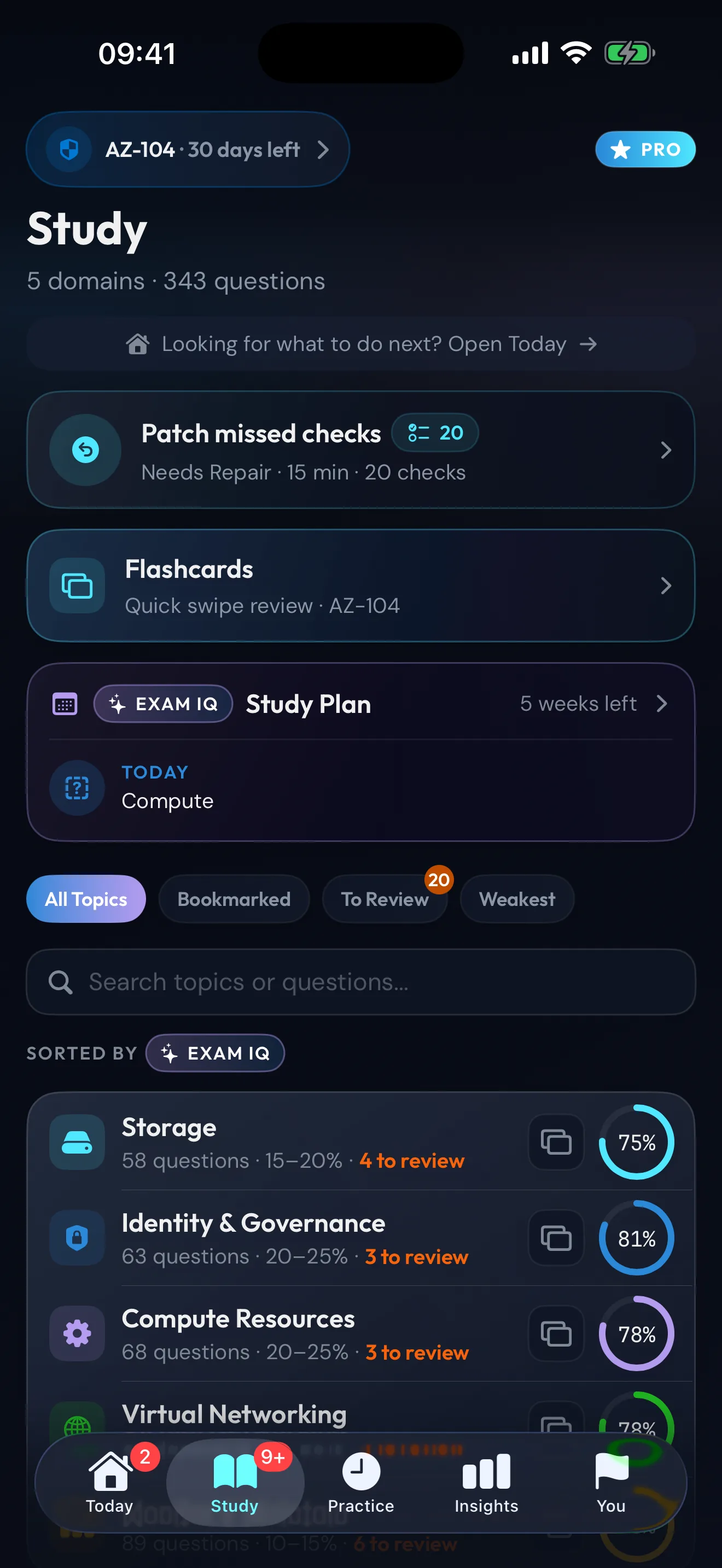
Azure Mastery writes a rationale for every option on every AB-620 question, so a wrong call on connector versus MCP tool teaches you the business constraint you missed, not just the score. Exam IQ gives you an on-device readiness score with a confidence range, and the study plan keeps circling back to your weak domain. Free to start, works offline.
Download Azure Mastery — freeExam day
Tactics for exam day
A few habits protect a settled, unhurried read.
- If you're sitting online, run the system check the night before and tidy your desk — the proctor pans the room on camera.
- Arrive early either way; the scenario questions reward starting calm.
- Aim for ninety seconds to two minutes on each question, flagging anything uncertain with mark-for-review rather than stalling.
- Read every scenario stem for the business constraint first — data residency, DLP, internal versus external audience — since AB-620 buries the deciding detail in a subordinate clause more often than the headline requirement.
- Clear every question inside a case study before you leave it — most lock once you move past them.
- 700 out of 1000 is the pass mark, and it's scaled: an unfamiliar configuration is just one question, not a verdict.
Frequently asked
AB-620 FAQs
How hard is the AB-620 exam?
Harder than the low-code label suggests, since it tests judgement under business constraints rather than tool familiarity. Expect a scenario naming a data-residency rule, a DLP policy, or an external-audience requirement that rules out an otherwise sensible answer. New to the platform? Budget extra hands-on time with topics, flows, and Dataverse together.
How long should I study for AB-620?
The six-week plan above is a practical start if you already work in Copilot Studio or the wider Power Platform. Extend it when Dataverse, Power Fx, and Foundry integration are all new at once. Use your domain-level results to decide when to add or repeat a week.
Do I need AI-901 before AB-620?
Not a formal prerequisite, but Microsoft's own path lists it as the current fundamentals route in. New to generative AI concepts? Sit AI-901 first for the vocabulary. Already building agents or automations in the Power Platform? Go straight to AB-620.
Is AB-620 the same as AI-103?
No. AB-620's audience profile expects familiarity with Microsoft Foundry alongside Copilot Studio, while AI-103 assesses building on Foundry itself. Separate credentials, and many teams hold both.
What is the passing score for AB-620, and does it expire?
700 out of 1000, scaled rather than a raw percentage, so it doesn't map to a fixed number of correct answers. Like other Associate certifications, AB-620 expires annually, with a free renewal assessment on Microsoft Learn inside the six-month window before expiry.
How much does AB-620 cost and can I retake it if I fail?
Fees differ by country, so check Microsoft's certification page for the cost where you live. If you don't pass:
- You can retake it after 24 hours the first time.
- The second and third retakes each need a 14-day wait.
- A ceiling of five attempts per rolling 12 months, each one booked fresh.
Ready to start on AB-620?
Get a rationale for every option on every AB-620 question, plus an adaptive plan that keeps returning to your weakest domain. The simulator runs at blueprint weight, and it's free to start.
Download Azure Mastery — free iPhone & iPad · Free to start · No account required