Guide
How to pass AB-100: Agentic AI Business Solutions Architect
A practical six-week route through planning, designing, and deploying agentic AI business solutions across Copilot Studio, Microsoft Foundry, and Dynamics 365 — plus the architecture trade-offs that catch experienced solution architects off guard.
The exam
What is AB-100, and is it for you?
Passing AB-100 satisfies the exam requirement for the Microsoft Certified: Agentic AI Business Solutions Architect credential, Microsoft's expert-tier certification for agentic AI business solutions.
- Covers architects designing end-to-end solutions across Microsoft Foundry, Microsoft 365 Copilot, Microsoft Copilot Studio, Dynamics 365, and the Power Platform; aimed at accomplished solution architects, not first-time AI candidates.
- Microsoft also requires one eligible associate certification alongside it; current options include AB-620 and AI-103.
- Sits at the top of Microsoft's agentic-AI stack: where AB-620 validates building a single agent in Copilot Studio and AI-103 validates code-first Foundry development, AB-100 expects cross-platform architecture calls between Copilot extensibility, Copilot Studio authoring, Foundry custom code, and embedded Dynamics 365 Copilot.
- It also expects you to design the ALM, governance, security, and ROI story for the resulting estate — an expert-level exam that, like AZ-305 or AZ-400, is terminal: no further exam builds on it.
- Became generally available on 1 May 2026, with skills last confirmed on 22 July 2026, so anchor your study to that live outline.
- Expect scenario-driven questions: a multi-paragraph business setup with a stated constraint, followed by a single architecture decision, rather than a definition to recall.
Format & domains
Exam format and skills domains
AB-100 mixes question styles: single-answer and multi-select items, ordering tasks around an ALM or governance process, and case studies that group several questions around one multi-platform business scenario.
- QuestionsRoughly 40–60
- Duration100 minutes (120-minute seat)
- Pass score700 / 1000 (scaled)
- DeliveryOnline or a test centre
- ValidityRenew free every year
- FeeVaries by country
The exam fee changes from country to country, so check Microsoft's certification page for the price where you live. AB-100 has just three skills domains, from the official July 2026 outline, shown below.
| Domain | Weight |
|---|---|
| Plan AI-powered business solutions | 25–30% |
| Design AI-powered business solutions | 25–30% |
| Deploy AI-powered business solutions | 40–45% |
- Deploy carries more weight than Plan and Design combined against either domain individually, and packs four separate skill groups — monitoring and tuning, testing, ALM, and responsible AI, security, and governance — so it earns the largest share of your study time.
- Plan and Design are lighter individually but still make up over half the paper between them.
Six-week study plan
A realistic six-week study plan
Use the six-week plan below as a starting point if you already architect solutions across Copilot Studio, Microsoft Foundry, and the Power Platform; extend it when one of those platforms is new to you.
It tracks Plan and Design as single weeks each, then splits Deploy — the largest domain — across three weeks to match its weight and its four skill groups.
-
Plan AI-powered business solutions
Cover the whole planning domain in one pass.
- Where agents fit in task automation, analytics, and decision-making; preparing data for grounding and reuse.
- AI strategy: the Cloud Adoption Framework's AI adoption process, multi-agent design across M365 Copilot, Copilot Studio, and Foundry, build versus extend, prompt-library guidelines.
- ROI and TCO criteria, build-versus-buy-versus-extend analysis, model routing.
-
Design AI and agents for business solutions
The design domain's first skill group.
- Copilot customisations and connectors across Dynamics 365 apps; agents integrated with Contact Center channels.
- The three agent archetypes: task, autonomous, prompt-and-response.
- Copilot Studio topics with fallback; AI in a Power Apps canvas app; NLP versus conversational language understanding versus generative AI orchestration.
-
Design extensibility, and orchestrate prebuilt agents
Custom builds first, then the prebuilt surfaces that need configuring rather than coding.
- Custom Foundry models; agents in M365 Copilot; agent extensibility in Copilot Studio via MCP and Computer Use.
- AI features in Dynamics 365 finance, supply chain, and customer-experience apps.
- Configuring M365 Copilot for Sales and Service; knowledge sources for in-app help.
-
Analyse, monitor, and test AI-powered solutions
The deploy domain starts here, and it's the largest on the exam.
- Process and tooling to monitor agents, analyse feedback and backlog, interpret telemetry for tuning.
- Validation criteria for custom models; Copilot prompt best-practice checks.
- End-to-end test scenarios spanning multiple Dynamics 365 apps.
-
ALM, responsible AI, security, and governance
Lifecycle design across four surfaces, then the security layer that wraps all of them.
- ALM for Copilot Studio agents and connectors, the Foundry Agents service, custom AI models, and Dynamics 365 apps.
- Security for agents and models; vulnerabilities including prompt manipulation.
- Data residency and access controls on grounding data; audit trails for model and data changes.
-
Review and exam simulation
Revisit the trade-off pattern that runs through every domain: distractors correct under a different constraint.
- Drill your weakest domain daily.
- Sit two full-length timed practice runs before you book.
Focus areas
The hardest AB-100 topics
AB-100 rewards architecture judgement over recall. These five areas deserve focused practice because the "correct" answer changes with the stated constraint.
Picking the right platform boundary
- M365 Copilot extensibility, Copilot Studio authoring, Foundry custom code, and embedded Dynamics 365 Copilot overlap in capability, and the exam tests which one is the primary surface.
- Practise naming the platform that owns a requirement, not just one that could technically do it.
Trade-off questions, not definition questions
- Most distractors are correct under a different constraint — cost versus latency, data residency, governance maturity, build-versus-buy.
- Isolate the stated constraint before you evaluate the options; two answers can both be technically sound and only one fits as written.
ALM across four different agent surfaces
- Copilot Studio agents, the Foundry Agents service, custom AI models, and Dynamics 365 apps each need a distinct lifecycle design.
- Know which promotion pattern, environment strategy, and versioning approach belongs to which surface, not one generic ALM answer.
Responsible AI, security, and governance as one skill
- AB-100 blends model security, prompt-manipulation mitigation, data residency, and audit trails into design decisions, not a compliance checklist.
- Expect a scenario naming a specific risk and asking which control addresses it, not a general principle to restate.
ROI, TCO, and the build-buy-extend call
- The Plan domain's cost-and-benefit skill group is easy to underrate, and it expects a genuine business case, not a gut call.
- Select ROI criteria and judge when to build, buy, or extend, rather than defaulting to custom because it's the most interesting option.
How to practise
Practise the way the exam works
AB-100 rewards judgement built through practice, not just reading Microsoft's architecture guidance.
- Practise making an architecture decision before you look at the answer options: read the full business scenario, identify its constraint, and explain why your design fits, then check the explanation for anything you missed.
- Revisit all three domains with spaced repetition, especially the separate skill groups in Design and Deploy.
- Complete at least two full-length timed practice tests before booking, to check your concentration holds through the later questions.
- Review each wrong answer afterwards to decide what to study next, rather than just noting the score.
Practise the trade-off, not the definition
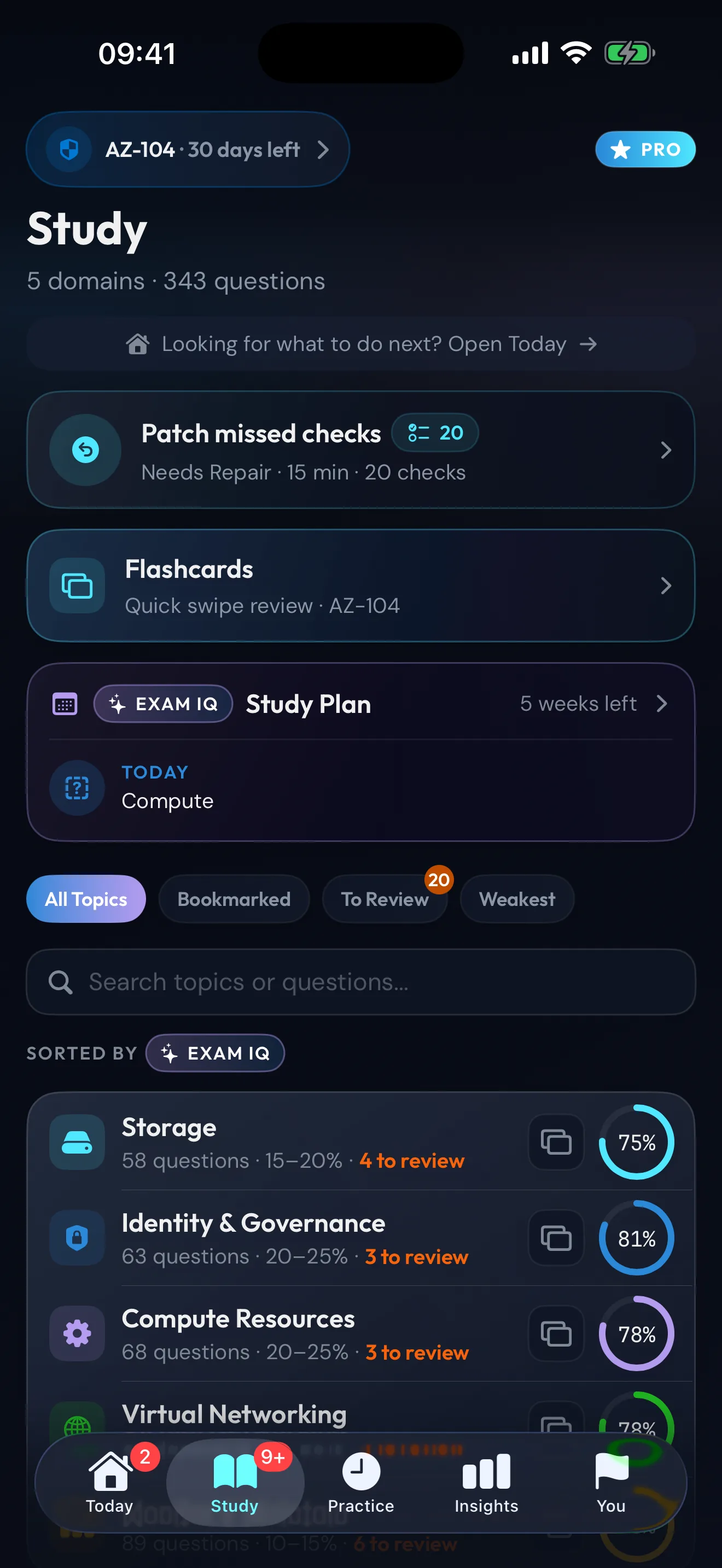
Azure Mastery writes a rationale for every option on every AB-100 question, so a wrong platform-boundary call teaches you the constraint you missed, not just the score. Exam IQ predicts your readiness on-device, the plan re-targets your weak domain, and the simulator runs at blueprint weight. Free to start, works offline.
Download Azure Mastery — freeExam day
Tactics for exam day
A few habits protect the marks you've already earned.
- Sitting online? Run the system check early and clear the desk down to bare surfaces before the proctor asks to see the room.
- Arrive early either way; scenario questions reward a settled, unhurried read over a rushed skim.
- Give yourself roughly ninety seconds to two minutes a question, flagging anything you pause on with mark-for-review.
- Read every business scenario for the stated constraint before you look at the options — AB-100 buries the deciding detail in a subordinate clause about cost, residency, or governance.
- Finish every question inside a case study before moving on — you can't usually go back once you've left it.
- The pass mark is 700 out of 1000 and it's scaled, so one unfamiliar scenario won't sink you: decide and move on.
Frequently asked
AB-100 FAQs
How hard is the AB-100 exam?
It asks you to make architecture decisions under business constraints, so it takes more than memorising feature names. Scenarios turn on cost, data residency, governance, or build-versus-buy — choose the design that meets the stated requirement. New to Copilot Studio, Foundry, or Dynamics 365? Allow extra hands-on practice.
How long should I study for AB-100?
The six-week plan above is a practical start if you already design solutions across Copilot Studio, Foundry, and the Power Platform professionally. Extend it when any platform is new territory — the exam expects familiarity across all of them, not depth in one. Use your domain results to decide when to repeat a week.
Do I need AB-620 or AI-103 before AB-100?
You need one eligible associate certification alongside AB-100, but Microsoft doesn't require AB-620 or AI-103 specifically — both are accepted, alongside several Dynamics 365 and Power Platform associate certifications. AI-901 is fundamentals-level and doesn't satisfy this requirement. Choose the associate route that matches your hands-on work.
Is AB-100 the same as AB-620 or AI-103?
What is the passing score for AB-100, and does it expire?
700 out of 1000, scaled rather than a raw percentage, so it doesn't map to a fixed number of correct answers. Like Microsoft's other certifications, AB-100 expires annually, with a free renewal assessment on Microsoft Learn inside the six-month window before expiry.
How much does AB-100 cost and can I retake it if I fail?
Exam pricing changes by country — check Microsoft's certification page for what it costs where you live. If you don't pass:
- First retake: available after 24 hours.
- Second and third retakes: a 14-day wait each.
- No more than five attempts in any rolling 12-month period, each booked separately.
Ready to start on AB-100?
Every AB-100 scenario ships with a rationale for each option, and Exam IQ gives you an on-device score with a confidence range before you sit the real thing. Free to start, and it works offline.
Download Azure Mastery — free iPhone & iPad · Free to start · No account required