AB-731: Predict your score.
Know what to study next.
See your predicted score, follow a study plan based on your answers, and revisit topics you're starting to forget. It all runs on your device.
335 practice questions
AI score prediction
100% offline
Download free
iPhone & iPad · Free to startOn your Mac? Scan to install
AB-731AI Transformation Leader
AB-731 · 30 days left ›
PREDICTED786 ±37✓ Exam Ready · 87% confidence
AB-731 Practice Questions & Exam Prep — Microsoft AI Transformation Leader
Get exam-ready for AB-731 (Microsoft AI Transformation Leader) on iPhone or iPad. Azure Mastery uses on-device AI to predict your readiness score across all three AB-731 domains — Business value of generative AI, Microsoft AI apps and services, and Implementation and adoption strategy — builds a personalised study plan from your weak spots, and surfaces topics you're forgetting. Core study stays on-device and works offline; optional sync uses your private iCloud account.
The exam
What is the AB-731 exam?
AB-731 is the Microsoft Certified: AI Transformation Leader credential — the no-code leadership exam for business decision-makers, programme leads, change managers, and AI champions responsible for driving AI adoption across teams and functions.
AB-731 validates that you can identify where generative AI adds business value, choose the right Microsoft AI app or service (Microsoft 365 Copilot, Copilot Studio, Microsoft Foundry), and lead an implementation and adoption strategy grounded in responsible AI, licensing trade-offs, and measurable ROI.
AB-731 is strategy-first, not hands-on. You aren't expected to write code, build an agent, or configure a tenant. You are expected to:
Articulate the difference between generative AI and classical ML
Frame token-based cost and ROI
Weigh build/buy/extend trade-offs across the Microsoft 365 Copilot extensibility framework
Set up an AI council and adoption programme
Apply Microsoft's responsible-AI principles — fairness, reliability and safety, privacy and security, inclusiveness, transparency, accountability
Expect scenario questions that put you in a CIO or programme-lead role and ask which Microsoft AI service or governance step fits the business need.
AB-731 is the leadership counterpart to the AB-620 builder track and the AB-900 admin track in Microsoft's Copilot and agents family. Every question in Azure Mastery's AB-731 bank is mapped to the current skills outline, including Copilot Chat vs Microsoft 365 Copilot, Researcher and Analyst use cases, and Foundry Tools. Read the official outline at learn.microsoft.com.
Questions30–40 mixed format
Duration45 minutes (65 min seat)
Pass score700 / 1000
CostUSD $99 (≈ £77 UK)
ValidityDoes not expire (Beginner)
FormatOnline or test centre
Skills measured · 22 July 2026
AB-731 exam objectives
Three domains, with weights set by Microsoft's 22 July 2026 update. Microsoft's own skill-group wording sits verbatim under each domain below, straight from the official outline, so you can pinpoint precisely where the gaps are.
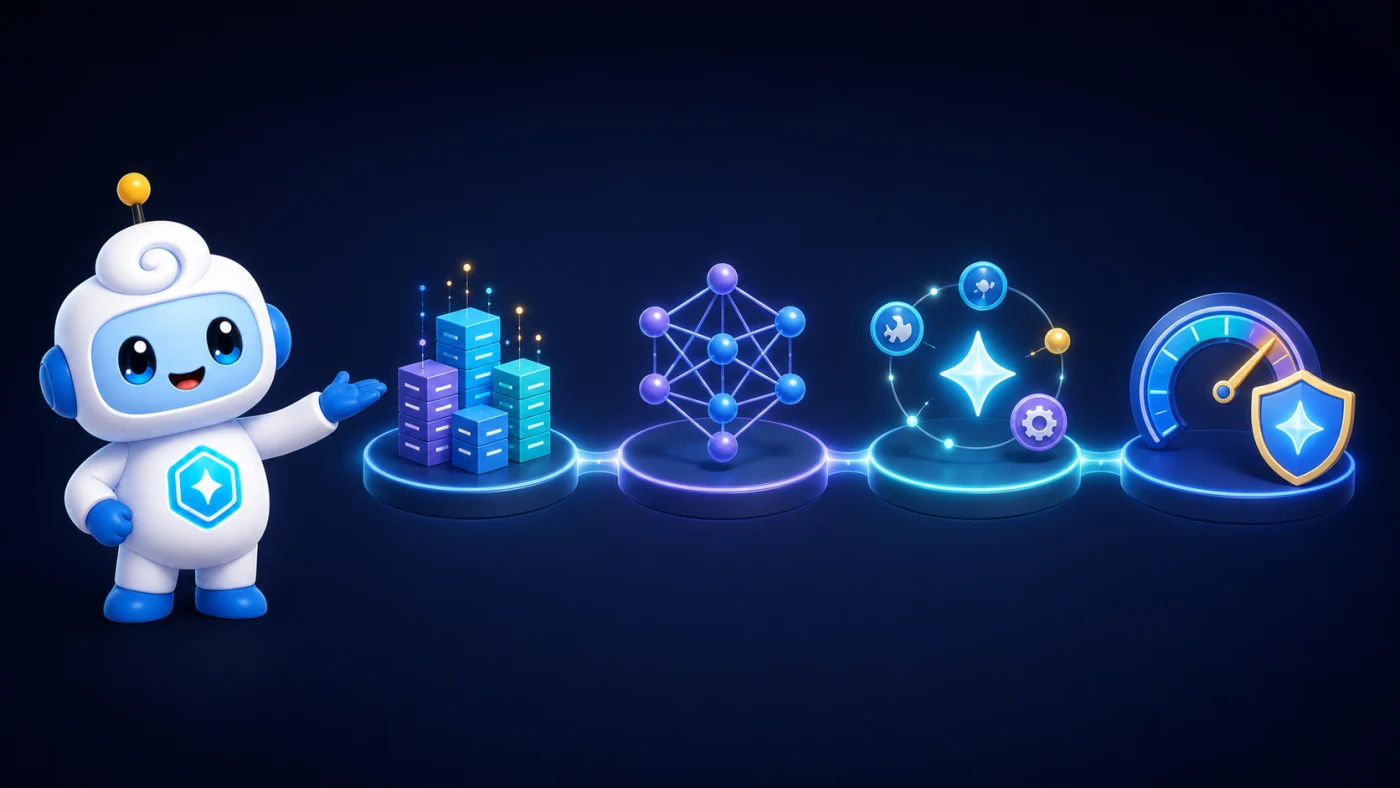
AI & agent skill mapDataModelsAgentsResponsible AI
Identify the business value of generative AI solutionsPublished weight 35–40%
126 exam-scoped practice questions in the app
Explore Value topics
Identify the foundational concepts of generative AI
Identify benefits and capabilities of generative AI solutions
Tests whether you can tell generative AI apart from discriminative, classical ML, and rule-based automation.
Candidates memorise cost drivers by name — tokens, prompt size, model choice — without applying them to a stated ROI case.
Learn what RAG buys you at a leadership level; you never need to write the prompt yourself.
Identify benefits, capabilities, and opportunities for Microsoft's AI apps and servicesPublished weight 35–40%
131 exam-scoped practice questions in the app
Explore Microsoft topics
Identify benefits and capabilities of Microsoft 365 Copilot and Microsoft Copilot
Identify benefits and capabilities of Foundry Tools
Every business process maps to one exact Microsoft surface, and finding it is the whole exercise.
Microsoft Copilot, Copilot Chat, and full Microsoft 365 Copilot get blurred into one product.
Learn each tier by what data it can see, since that's what the exam actually asks about.
Identify an implementation and adoption strategy for Microsoft's AI apps and servicesPublished weight 20–25%
78 exam-scoped practice questions in the app
Explore Strategy topics
Align an AI strategy with Microsoft responsible AI policies
Plan for AI adoption across the organization
Build, buy, and extend trade-offs alongside governance structures and adoption metrics are what's assessed here.
This domain gets treated as an afterthought, and marks get lost on the softer governance material.
Learn the Copilot Dashboard and adoption metrics as seriously as the two larger technical domains.
Common traps
Where AB-731 candidates slip
Three recurring misconceptions that trip up otherwise well-prepared AB-731 candidates, grounded in the current skills outline.
Microsoft Copilot, Copilot Chat, and Microsoft 365 Copilot are three different entitlements
All three share a name and a chat window, which is exactly why AB-731 tests the difference between them.
Microsoft 365 Copilot uses organisational context from Microsoft Graph broadly, while Copilot Chat is web-grounded by default.
Copilot Chat can still use organisational content that a user explicitly provides or accesses through an agent, so check the scenario's licence and grounding path rather than ruling it out automatically.
Generative AI and classical machine learning solve different problems
AB-731 expects you to place a described capability on the right side of the ML/AI line before you evaluate it.
The exam is testing whether you know a model predicting a numeric outcome is discriminative, not generative.
Check what the model actually produces before judging its cost or risk profile.
Build, buy, and extend are three different commitments, not synonyms for "use AI"
AB-731 stems hide a licensing or engineering-effort constraint inside the wording of a proposal.
A described agent has to be sorted into build, buy, or extend before any recommendation makes sense.
Match declarative agents to extend, a custom Foundry engine to build, and an existing licence to buy.
Designed for AB-731
How Azure Mastery helps you pass AB-731
Exam-specific practice
335 AB-731 practice questions, split across generative AI fundamentals, Microsoft's AI products, and adoption strategy.
The two largest domains each carry 35–40% of the published weight, so rehearsal weights them equally.
Practise framing ROI and sorting a proposal correctly into build, buy, or extend.
Predicted score
Exam IQ predicts your AB-731 score on-device after roughly 25 questions, with a confidence range attached.
An early prediction reads mostly on how solidly you know Microsoft's AI product lineup.
See which of the three domains is holding your readiness back before you book.
Adaptive study plan
Miss a build/buy/extend question and the next session surfaces another extensibility-framework question.
Master a topic across three sessions and the plan moves on to the next-highest gap.
The two 35–40% domains get proportionally more rehearsal than the smaller strategy domain.
Knowledge decay
Microsoft's AI product line moves fast, so a Copilot-tier distinction studied once fades quickly.
Azure Mastery tracks every topic's decay curve and nudges you back before a fading topic lapses.
Weak-spot drills pull decayed topics back into rotation ahead of anything you've never missed.
Exam rehearsal
Each Exam Simulator run matches AB-731's shorter 45-minute format, not a longer Associate-exam clock.
The mix is weighted to the current domain percentages, built from original questions.
Microsoft controls the live interface and exact item mix, not this app.
Answer Coach
Names the shelf you reached for — Copilot confused with Copilot Chat, build confused with extend — before the right one.
The fix targets the judgement call, not a fact you'd already half-known.
Every correction sits ready in your missed-answers list, authored first, on-device only after a grounding pass.
Aura guidance
Aura leans toward the ROI and Copilot-tier questions that trip people up early in week one.
A short recap after every session spells out what moved and where to look next.
Private by design
Your AB-731 answer history, readiness prediction, and coaching stay on your device by default.
iCloud sync is optional and private, with no account standing between you and your first question.
Nothing about your prep leaves the device unless you choose otherwise.
4-week study plan
Suggested AB-731 study plan
Work through AI business value, Microsoft services and adoption decisions. Use the final week of this four-week route for review and timed practice.
AI business value
Compare generative AI, classical ML and rule-based automation.
Assess cost, ROI, risks and responsible AI principles.
Review prompting, grounding, RAG and the ML lifecycle.
Microsoft AI services
Distinguish Microsoft Copilot, Copilot Chat and Microsoft 365 Copilot.
Explore app integrations, Graph grounding, Researcher and Analyst.
Compare Copilot Studio, Foundry Tools and model options.
Implementation and adoption
Compare build, buy and extend choices and licensing models.
Plan governance, AI champions and change management.
Review adoption with Copilot Dashboard, Copilot Analytics and Viva Insights.
Review and rehearse
Use Focus Weak Spots to revisit weaker areas.
Complete two timed, 45-minute Exam Simulator sessions.
Review service-selection and build, buy or extend decisions.
Inside the app
Nine interactive practice formats, on iPhone
Azure Mastery has nine interactive formats for exam practice. The examples below show original AB-731 practice questions in Azure Mastery on iPhone and iPad. The exam simulator uses timed sessions with the published domain weights. Microsoft's live interface and question mix may differ.
How many core principles does Microsoft's Responsible AI Standard define?
Twelve
Ten
Six
Three
Multiple choice
An original AB-731 practice question with one correct answer. The app explains every option after you answer.
Exam-specific sample
Which TWO Microsoft services give a leader the clearest visibility into how Microsoft 365 Copilot is being used and what data is touched? Select two answers.
Microsoft Defender for SQL
Purview DSPM for AI
Azure ExpressRoute
Copilot Analytics in the M365 admin centre
Multi-select
An original AB-731 multi-select question. Select all the correct options to earn the mark.
All-or-nothing
Order the phases of the Microsoft Cloud Adoption Framework approach to AI, from first to last.
⋮⋮1Strategy: define motivations, use cases, and business value
⋮⋮2Plan: prioritize use cases and build an actionable plan
⋮⋮3Ready: prepare environment, skills, and resources
⋮⋮4Govern: establish responsible AI governance and policies
⋮⋮5Secure: protect the AI workloads, data, and identities
Drag-and-drop
An original AB-731 ordering question you can answer by touch on iPhone and iPad.
Interactive item
Complete the cost statement for a leader comparing metered AI usage with predictable billing. Per-call generative AI cost scales with {{b1}}. For intermittent usage,…
Dropdown selection
An original AB-731 question with a visual prompt, designed for touch on iPhone and iPad.
Choose in context
Northwind Traders — Leading Microsoft 365 Copilot adoption Northwind Traders is a mid-size distributor whose leadership wants to use Microsoft 365 Copilot to improve productivity. The transformation leader must turn enthusiasm…
1How should Northwind choose its first Copilot use cases?
2Which action best builds the people side of Copilot adoption?
3For a need that out-of-the-box Copilot almost meets but that requires grounding…
4What should Northwind do about inconsistent SharePoint permissions before a…
Case studies
An original AB-731 case study with several questions about the same requirements and environment.
Multi-question
✕Your answer: Twelve
✨ Answer Coach:Twelve is far more than the six principles the Responsible AI Standard defines.
— grounded in authored certification guidance
Answer Coach
Answer Coach explains why the answer is correct and, where available, why each option is right or wrong. It helps you understand a mistake and remember the distinction. Read explanations after each question or at the end of a practice test. On supported devices, optional AI can reword a note on your device after checking it against the written guidance.
App exclusive
Frequently asked
AB-731 FAQs
Do I need any coding background before AB-731?
No. AB-731 is a no-code, leadership-level exam — you're not expected to build an agent or write Power Fx. Microsoft expects working knowledge of Microsoft 365 and a sense of how generative AI differs from earlier AI. If that's new, AI-901 is a reasonable warm-up, though not a formal prerequisite.
What does the AB-731 exam format actually look like?
AB-731's published guidance is 30–40 questions in mixed formats over a 45-minute session. Azure Mastery's bank weights single-answer and scenario items most heavily, with multi-select, drag-to-match, and case-study questions layered in — all original practice content.
AB-731 vs AB-620 — which is right for me?
Different jobs. AB-731 is the leadership credential for decision-makers framing ROI, choosing build/buy/extend, and running adoption programmes. AB-620 is the maker credential for low-code builders shipping agents in Copilot Studio. Pick AB-731 to lead change, AB-620 to build.
AB-731 vs AB-900 — what's the difference?
Different audiences. AB-900 is the IT admin's Fundamentals exam — admin centres, governance, licensing, agent approval flows. AB-731 is the business leader's exam — ROI, adoption strategy, responsible AI, and build/buy/extend decisions. Programme leads sometimes take both.
AB-731 vs AI-901 — business leader or technical fundamentals?
Different audiences. AB-731 is a no-code, Beginner-tier exam for decision-makers spotting AI opportunities and driving adoption. AI-901 expects technical grounding — Python, Azure resources, Foundry — for people starting a technical AI career. A programme lead wants AB-731; an engineer wants AI-901.
What does the AB-731 exam fee cover?
AB-731 is Beginner-tier: the voucher is USD $99 in the US, around £77 in the UK. Microsoft occasionally offers free vouchers via Build, Ignite, or virtual training events, so check your Learn profile before booking. Pricing varies by region.
What is the AB-731 retake policy if I fail?
Each retake needs its own voucher, and the wait depends on your attempt number.
First retake: after 24 hours.
Second and third retakes: a 14-day wait each.
Cap: five attempts per rolling 12 months.
How long should I study for AB-731?
Most decision-makers pass after three to five weeks of focused study, assuming familiarity with Microsoft 365 and basic generative-AI concepts. You don't need to build agents, but you do need to articulate ROI, licensing, and adoption frameworks. Don't book until the readiness gauge shows 720 or higher.
Can I try Azure Mastery's AB-731 content before paying?
The app is free to download, with a free allowance of AB-731 questions to try every feature first. The full bank of 335 AB-731 practice questions unlocks with a one-time exam-pack purchase, or unlock every exam with a subscription or lifetime upgrade.
Does AB-731 practice work offline?
Yes — every part of practice runs locally: questions, scoring, and the readiness read. A flight or a signal-free commute doesn't interrupt a session. No account is needed, and data stays on your device until you turn on optional iCloud sync.
Free study guides
Free guides that pair with AB-731
Where AB-731 fits
Certification paths that include AB-731
AB-731 is Microsoft's leadership credential for business decision-makers driving AI transformation. It sits alongside AB-620 (the maker track) and AB-900 (the admin track) in the Copilot and agents family — three credentials for three distinct roles. Tap any linked exam below to see its dedicated study app page.
AB-731 is the leadership credential for AI transformation. AI-901 is the current Azure AI Fundamentals route; AB-620 is the natural pairing for programme leads who also want hands-on Copilot Studio fluency.
Ready to pass AB-731?
Download Azure Mastery free. 335 AB-731 practice questions across all three domains, AI score prediction, full-length exam simulator, adaptive study plan. iPhone & iPad.