Guide
How to pass SC-500: Cloud and AI Security Engineer
A practical six-week route through identity, storage, network, compute, and AI security — plus posture management — for Microsoft's newest security engineering exam, the exam that replaced AZ-500.
The exam
What is SC-500, and is it for you?
SC-500 earns the Microsoft Certified: Cloud and AI Security Engineer Associate credential, spanning identity, network, application, data, and compute security across cloud and hybrid environments.
- Targets security engineers who now also help secure the platforms, data, and infrastructure behind AI workloads, not just traditional infrastructure.
- It's the direct successor to AZ-500 (Microsoft Azure Security Engineer), which retired on 31 August 2026 — most of its identity, storage, database, network, and compute security content carries over largely unchanged.
- What's genuinely new is a dedicated Secure compute for AI skill group: Purview Data Security Posture Management for Copilot, Microsoft Entra Agent ID, AI Gateway in API Management, Defender for AI Services, and Foundry guardrails.
- Became generally available on 1 July 2026, so it's still a young credential and the AI-security content especially has little third-party prep material.
- Expect scenario-driven questions built around GA features, with occasional coverage of commonly used preview capabilities.
- Skills measured were last confirmed on 13 May 2026 — anchor your study there, not to older AZ-500 material, which covers a different, retired exam.
Format & domains
Exam format and skills domains
SC-500 mixes question styles: single-answer and multi-select items, ordering tasks around a configuration or investigation workflow, and case studies that group several questions around one security-engineering scenario.
- QuestionsRoughly 40–60
- Duration100 minutes (120-minute seat)
- Pass score700 / 1000 (scaled)
- DeliveryOnline or a test centre
- ValidityRenew free every year
- FeeVaries by country
The exam fee changes from country to country, so check Microsoft's certification page for the price where you live. The four skills domains and their weights, from the official May 2026 outline, are below.
| Domain | Weight |
|---|---|
| Manage identity, access, and governance | 20–25% |
| Secure storage, databases, and networking | 25–30% |
| Secure compute | 20–25% |
| Manage and monitor security posture | 20–25% |
Secure storage, databases, and networking is the largest single domain, covering Defender for Storage and Databases, Azure SQL auditing, private endpoints and Private Link, network security groups, and Azure Firewall. Secure compute is where the AI-security content lives — the clearest differentiator from AZ-500 — and deserves focused attention even though its weight matches the other two remaining domains.
Six-week study plan
A realistic six-week study plan
Use the six-week plan below as a starting point if you already administer Azure security day to day; extend it when Microsoft Sentinel, Entra Agent ID, or the AI-security controls are unfamiliar. It gives the largest domain — storage, databases, and networking — two full weeks, with the remaining three domains taking one week each.
-
Manage identity, access, and governance
The smallest domain, covered in full this week.
- Entra ID: PIM, Conditional Access, MFA and passwordless, application identities, OAuth consent, managed identities.
- Key Vault: deployment, access policies, firewall rules, Defender for Key Vault.
- Governance: Azure Policy, Defender for Cloud compliance standards, resource locks, RBAC, IaC controls.
-
Secure storage and databases
The largest domain starts here.
- Storage: firewall rules, Defender for Storage, access policies.
- Databases: Azure SQL platform-level security, database auditing, Defender for Databases.
-
Secure Azure network services
Networking closes out the largest domain.
- NSGs and ASGs; Virtual Network Manager access policies; Virtual WAN security; VPN connections.
- Entra Private Access; private endpoints and Private Link for PaaS; Azure Firewall; effective rules via Network Watcher.
-
Secure compute: AI, servers, and the application platform
Give the headline addition over AZ-500 a deliberate deep dive before the more familiar compute topics.
- AI security: Purview DSPM for Copilot and AI apps, real-time protection for Copilot Studio agents, Conditional Access and blast-radius analysis for Entra Agent ID, AI Gateway, Defender for AI Services, Foundry guardrails.
- Servers and VMs: disk encryption, Azure Bastion, just-in-time access, Azure Arc, Defender for Servers, secure boot and vTPM.
- Application platform: Defender for Containers, AKS, Container Apps, Functions, Logic Apps, App Service, WAF.
-
Manage and monitor security posture
Three tools, one domain.
- Defender for Cloud CSPM, compliance frameworks, workload protection plans, multicloud AWS/GCP connectors.
- Sentinel ingestion: workspaces, data connectors, syslog/CEF, Windows event collection, automation rules and playbooks.
- Microsoft Security Copilot: workspaces, permissions, plugins, agents.
-
Review and exam simulation
Revisit the control-layering distinctions the exam leans on hardest, then prove you're ready.
- Which Defender for Cloud plan covers which resource, and which network-access control fits which pattern.
- Drill your weakest domain daily, then sit two full-length timed practice runs before you book.
Focus areas
The hardest SC-500 topics
SC-500 covers many security controls with similar names. Focus on these five areas and practise choosing the control that fits each threat.
The AI-security control set
- Purview DSPM, Entra Agent ID Conditional Access, AI Gateway, Defender for AI Services, and Foundry guardrails all touch AI workloads but stop different threats.
- Match the named risk to the one control that addresses it: data overexposure, agent identity misuse, model-endpoint abuse, or runtime prompt attacks.
Private network access patterns
- Private endpoints, Private Link, Entra Private Access, and Virtual Network Manager all restrict access differently.
- Pick the one that fits the pattern — a PaaS resource, a user outside Azure, or centralised policy across many networks — not the one you know best.
Which Defender for Cloud plan covers what
- CSPM and the individual plans for Storage, Databases, Servers, Containers, and Key Vault overlap in the dashboard but protect different resource types.
- Questions naming a specific resource and threat expect the specific plan, not a generic "enable Defender for Cloud" answer.
Governance layering: policy, RBAC, and locks
- Azure Policy, RBAC, resource locks, and Key Vault access policies each stop a different kind of misconfiguration.
- SC-500 tests which layer actually prevents the scenario: an accidental deletion, an overprivileged assignment, or a non-compliant resource being created.
Matching a Sentinel ingestion method to the source
- Built-in connectors, syslog/CEF forwarding, data-collection-rule Windows Event collection, and custom log tables all get data in, but each suits a different source and licensing model.
- Read a source description and name the correct ingestion path rather than defaulting to whichever is most familiar.
How to practise
Practise the way the exam works
SC-500 rewards matching a control or plan to a scenario, a skill built through practice more than reading.
- After reading Defender for Cloud documentation, practise matching a control or plan to a scenario, choosing your answer before reading the explanation.
- Give the AI-security topics extra time, especially if most of your experience comes from AZ-500.
- Revisit all four domains with spaced repetition: identity, storage and networking, compute, and posture management.
- Complete at least two full-length timed practice tests before booking, and check whether your accuracy holds up in the later questions.
- Review each wrong answer afterwards to decide what needs more practice.
New AI-security content, the same rigour
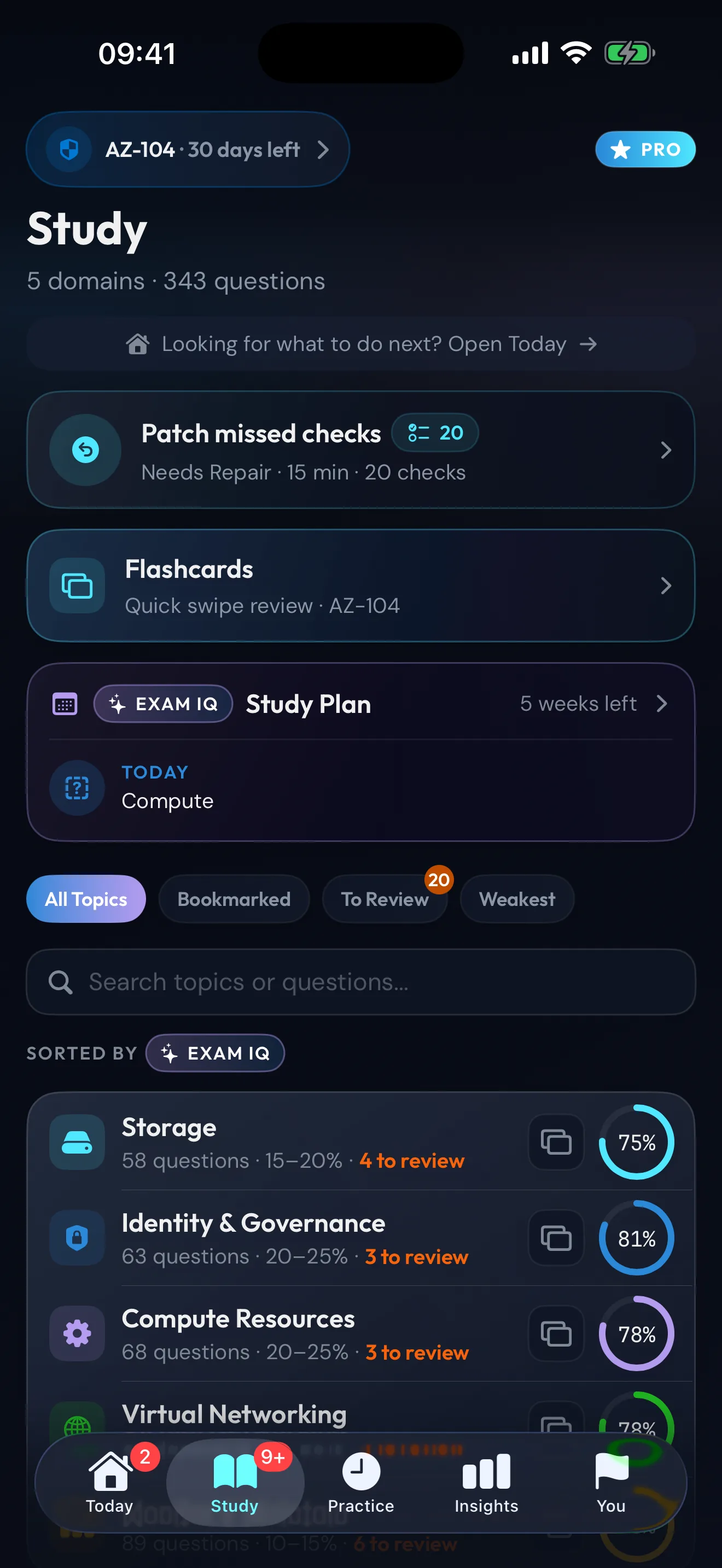
Azure Mastery writes a rationale for every option on every SC-500 question, so a wrong call on Purview DSPM versus Defender for AI Services teaches you the distinction, not just the score. Exam IQ gives you an on-device readiness score with a confidence range, and the study plan keeps circling back to your weak domain. Free to start, works offline.
Download Azure Mastery — freeExam day
Tactics for exam day
A few habits protect the marks you've already earned.
- Sitting online? Run the system check the day before and clear your desk — proctors ask you to show the room first.
- Arrive early either way; a rushed start eats into your focus during the dense scenario questions.
- Budget roughly ninety seconds to two minutes per question, and flag anything you pause on with mark-for-review.
- Read every network or Defender-for-Cloud question twice — the trap is usually one scope, resource type, or plan name.
- Answer everything inside a case study before you advance; you generally cannot return to one once you leave it.
- Remember the pass mark is 700 out of 1000, scaled. An unfamiliar configuration isn't a disaster: make your call and keep moving.
Frequently asked
SC-500 FAQs
How hard is the SC-500 exam?
Broad rather than deep: identity, storage, database, network, compute, and AI security, plus posture management, so breadth of recall matters as much as depth on any one topic. Give the newer AI-security material — Entra Agent ID, Purview DSPM, Defender for AI Services, Foundry guardrails — dedicated hands-on revision.
How long should I study for SC-500?
The six-week plan above is a practical start if you already administer Azure security day to day. Extend it when Sentinel, Entra Agent ID, or the AI-security controls are unfamiliar, since several are recent additions. Use your domain-level results to decide when to add or repeat a week.
Do I need AZ-500 or SC-200 before SC-500?
Neither is a formal prerequisite. Microsoft expects practical experience administering Azure and hybrid environments and strong Entra ID familiarity — the background AZ-500 or day-to-day cloud security work already gives you. Partway through AZ-500 prep? That study carries over directly.
Is SC-500 the same as AZ-500?
SC-500 is the direct successor to AZ-500, which retired on 31 August 2026. Most of AZ-500's identity, storage, database, network, and compute content carries over unchanged. The new part is Secure compute for AI — Purview DSPM, Entra Agent ID, AI Gateway, Defender for AI Services, Foundry guardrails — which didn't exist on AZ-500.
What is the passing score for SC-500, and does it expire?
700 out of 1000, scaled rather than a raw percentage, so it doesn't map to a fixed number of correct answers. Like other Associate certifications, SC-500 expires annually, with a free renewal assessment on Microsoft Learn inside the six-month window before expiry.
How much does SC-500 cost and can I retake it if I fail?
Pricing varies by country — check Microsoft's certification page for your local fee. If you don't pass:
- First retake: available 24 hours later.
- Second and third retakes: each requires a 14-day wait.
- Maximum five attempts per rolling 12 months, each a fresh booking.
Ready to start on SC-500?
SC-500's AI-security material is new to almost everyone — Azure Mastery gives every option a rationale and predicts your score on-device with Exam IQ before you book. Free to start.
Download Azure Mastery — free iPhone & iPad · Free to start · No account required